Car Segments in Pakistan: A to S Explained
Why does a bigger-looking car belong to a different class? Explore Pakistan’s A–F segments, SUV categories, size, space, price and positioning.
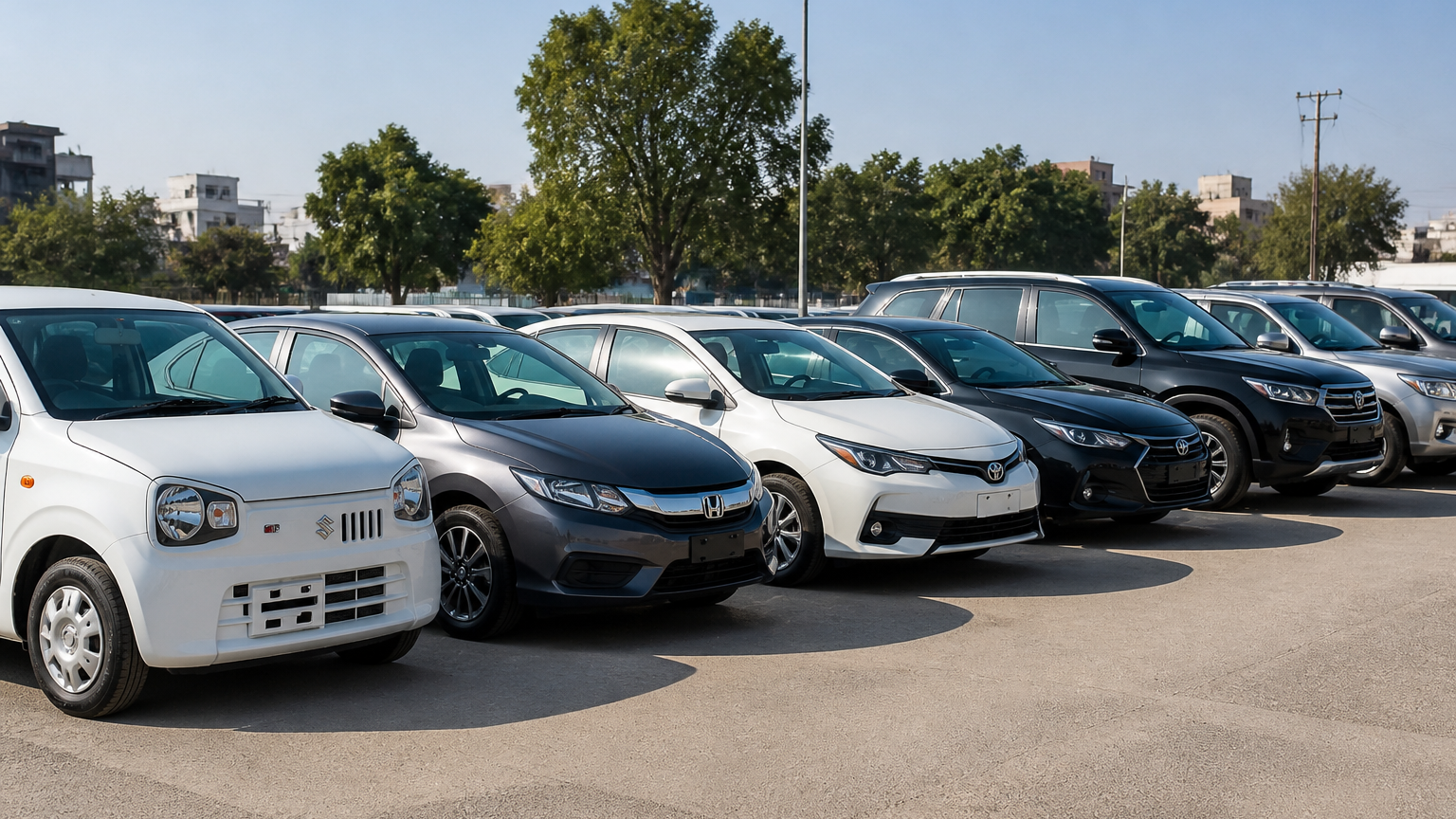
A lot of buyers in Pakistan trust their eyes first. Park a Honda Civic beside a Kia Sportage L, and the SUV can look much bigger even though the Civic is slightly longer. That is why car segments matter. They help explain why some cars feel more spacious, some cost more to own, and some belong to a different class even when they look similar on the road.
How car segments really work
A vehicle segment is not decided by size alone. Makers and market experts also look at interior space, road use, pricing, target buyers and overall positioning. That is why two cars with close dimensions can still fall into different classes.
The common passenger-car system used in many markets runs from A to F. There are also separate families for SUVs, MPVs and sports cars.
A to F: the main passenger-car groups
A-segment cars are the smallest everyday cars. In Pakistan, this includes models like the Suzuki Alto, Kia Picanto, Daihatsu Mira and Honri Ve. These cars are valued for low running costs and easy city driving, but they usually have limited cabin and luggage space.
B-segment cars step up in size and comfort. This group includes the Suzuki Swift, Honda City, Toyota Yaris, Changan Alsvin and Dongfeng Box. Hatchbacks and sedans can both sit in this class, so a boot does not automatically push a car into a higher segment.
C-segment cars are among Pakistan’s most familiar family cars. The Toyota Corolla, Honda Civic, Hyundai Elantra, Toyota Prius and MG4 EV sit here. This is often the sweet spot for space, comfort and price.
D-segment cars are larger sedans made for more comfort on longer trips. Examples include the Hyundai Sonata, Honda Accord, BYD Seal and Deepal L07. These cars often focus more on refinement than basic practicality.
E-segment cars move into executive territory, with models like the Mercedes-Benz E-Class, BMW 5 Series and Audi A6.
F-segment cars are the top end of regular passenger-car luxury. The Mercedes-Benz S-Class, BMW 7 Series, Audi A8 and Mercedes-Benz EQS belong here.
One important point for buyers: a premium C-segment car can cost more than a mainstream D-segment car without offering more cabin space.
SUVs are not one single category
SUVs also have size bands inside the broader J-segment.
B-SUVs include cars like the Kia Stonic, Jaecoo J5, Peugeot 2008, Toyota Raize and Honda HR-V.
C-SUVs include the Kia Sportage L, Hyundai Tucson, Haval H6, Jaecoo J7 and Chery Tiggo 7.
D-SUVs include the Chery Tiggo 9, Chery Tiggo 8, Kia Sorento, Hyundai Santa Fe and Toyota Fortuner.
Full-size SUVs include the Toyota Land Cruiser LC300, Range Rover and BMW X7.
This is why body style alone does not decide class. A small SUV is still a small SUV, even if it looks tall and bold.
MPVs and sports cars have different goals
MPVs are built for people and cargo space, not flash. Models such as the Changan Karvaan, Kia Carnival, Suzuki Every and Suzuki MR Wagon focus on upright seating and flexible cabin use. In some cases, an MPV can offer more usable room than an SUV of similar length.
S-segment sports cars are built around performance and style. Examples include the Toyota Supra, MG Cyberster, BMW Z4 and Lamborghini Huracán.
Why the Civic can seem smaller than the Sportage L
The numbers help explain the visual trick. The Civic is listed at 4,695 mm long, 1,802 mm wide and 1,432 mm tall. The Sportage L facelift is 4,685 mm long, 1,865 mm wide and 1,660 mm tall.
So the Civic is slightly longer, but the Sportage is wider and much taller. That extra height, along with higher ground clearance and upright bodywork, gives the SUV more road presence.
Which segment should you choose?
That depends on how you use the car.
- Mostly city driving: A-segment or B-segment
- Family daily use: B-segment, C-segment or a compact SUV
- Long trips and comfort: D-segment or E-segment
- Large family needs: MPV or mid-size SUV
- Luxury and performance: E, F or S-segment
Higher segments can bring more comfort, but they also often mean higher insurance, fuel, tyre and maintenance costs. Parking can also become harder in busy Pakistani cities.
If you are comparing cars, do not start with the badge or body shape. Start with passengers, routes, budget and running cost. That usually gives a better answer than size alone.
For a related buyer guide, see PDI Explained: Check Your New Car Before Delivery.
Explore DrivePK services
Buying or selling a vehicle? Explore DrivePK services, including car inspection, Sell It For Me and Featured Listings, and choose the option that fits your needs.
For more updates, visit DrivePK.com
Share this article
About the author

Dr Khan
Automotive expert and content strategist
Comments (0)
Sign in required
Sign in to comment on this article.
No comments yet. Be the first to share your thoughts!