Honda Vezel Auction Sheet: 7 Checks Before Buying
A high auction grade isn’t a guarantee. Learn seven checks to verify a 2015 Honda Vezel’s identity, history, documents, and condition in Pakistan.
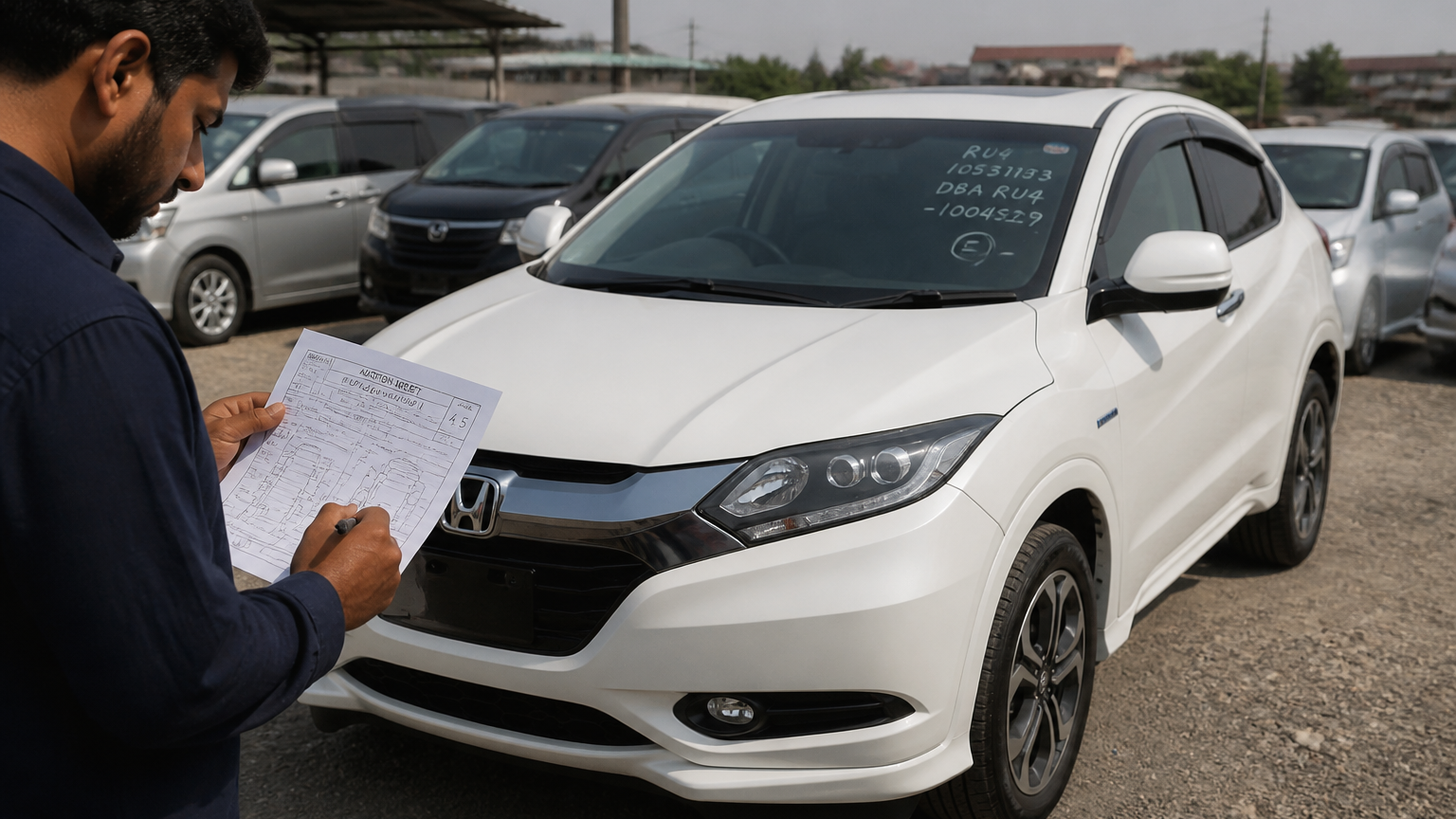
A 2015 Honda Vezel Hybrid Z can look perfect on paper: Grade 4.5, genuine mileage, and original paint. But that paper only tells you how the car was judged in Japan at one point in time. Before you pay a token, the auction sheet must be matched against the car, its documents, and its current condition in Pakistan.
For used Japanese imports, the auction sheet is one of the most useful records you can get. It shows the car’s condition when it went through auction, but it does not prove the vehicle is still in the same shape today. That is why buyers should check seven key details.
1) Confirm the model and variant
Start with the basics: make sure the sheet belongs to the exact Vezel you are buying. First-generation Vezels from 2013 to 2021 use RU1 and RU2 for petrol models, while RU3 and RU4 are hybrid versions. Second-generation models from 2021 onward use RV3 and RV4 for petrol, and RV5 and RV6 for hybrid versions. For background, read our earlier coverage: Honda Super-One EV Unveiled, Small Size, Big Performance.
This matters because a 2015 Hybrid Z and a 2022 e:HEV Z are not the same car. They use different systems and different chassis codes. Do not rely on badges, bumpers, or alloy wheels alone, because these parts can be changed after import.
2) Match the full chassis number
The complete chassis number should match across the car, the auction sheet, and the import papers. A partial code is not enough. If the numbers do not line up, stop and investigate before paying.
3) Read the auction grade correctly
A Grade 4.5 car is usually in good condition, but that does not mean it has no scratches, repairs, or hidden issues. Grade 4 means generally good used condition, while Grade 3.5 usually points to more visible wear or repair marks. R and RA grades mean the car has repair history under the auction house’s system.
Grades help you compare cars, but they do not guarantee perfect paint or perfect mechanical health.
4) Study the damage diagram
The diagram is often more useful than the grade number. Common markings include A1 to A3 for scratches, U1 to U3 for dents, W1 to W3 for repair marks, X for a panel marked for replacement, and XX for a panel that has already been replaced.
A small bumper scratch is very different from damage on a pillar or quarter panel. Structural areas need much closer attention than cosmetic marks.
5) Translate the inspector’s remarks
Japanese remarks can mention unusual noises, warning lights, rust, corrosion, water damage, stains, odors, or repaired panels. These notes should be translated properly. Do not depend only on a seller’s explanation.
A remark is a warning sign, not final proof of a major fault, but it does mean the car needs more checking.
6) Check dates and mileage carefully
Do not mix up the model year, auction date, Japanese registration date, import date, and Pakistani registration date. A car auctioned in 2018 and registered in Pakistan in 2019 is still a 2015 model if that was its production year.
Mileage also needs a close look. If the auction sheet shows 72,000 km but the current odometer reads 58,000 km, that is a red flag. Ask for service records and any available inspection history before trusting the reading.
7) Compare auction photos with the car in front of you
If auction photos are available, compare them with the Vezel you are seeing now. Check the headlights, bumpers, wheels, paint shade, panel gaps, and any visible damage. A repaired bumper or repainted panel is not always a bad thing, but it must be disclosed and inspected.
What the sheet cannot tell you
Even a real auction sheet cannot tell you the current condition of the hybrid battery, transmission, suspension, or electrical system. That is especially important for first-generation Hybrid models with Honda’s i-DCD system, which should be checked for gear engagement issues, jerking, warning lights, and fault codes. For background, read our earlier coverage: Atlas Honda Digital Warranty Starts for New Bikes.
Second-generation e:HEV models use a different hybrid setup, so they should not be judged by the same transmission concerns.
Final advice for buyers
Proceed only when the chassis number matches, the auction record makes sense, and an independent inspection supports the seller’s claim. Negotiate if repairs are cosmetic and clearly explained. Walk away if the seller refuses verification or the mileage and damage history cannot be reconciled.
Explore DrivePK services
Considering a Japanese import? Explore DrivePK Auction Sheet Verification to check the available auction record before making a decision.
For more updates, visit DrivePK.com
Share this article
About the author

Dr Khan
Automotive expert and content strategist

Comments (0)
Sign in required
Sign in to comment on this article.
No comments yet. Be the first to share your thoughts!