Toyota Fortuner 2.8 Sigma 4 (2026) vs Tank 500 PHEV (2026): Buyer Comparison
A body-on-frame diesel SUV faces a plug-in-hybrid rival here. The Fortuner leans on simpler 4x4 hardware and documented local fuel figures, while the Tank 500 PHEV brings more power, electric-only range and a richer equipment set, but also charging dependence and a newer Pakistan-market track record.
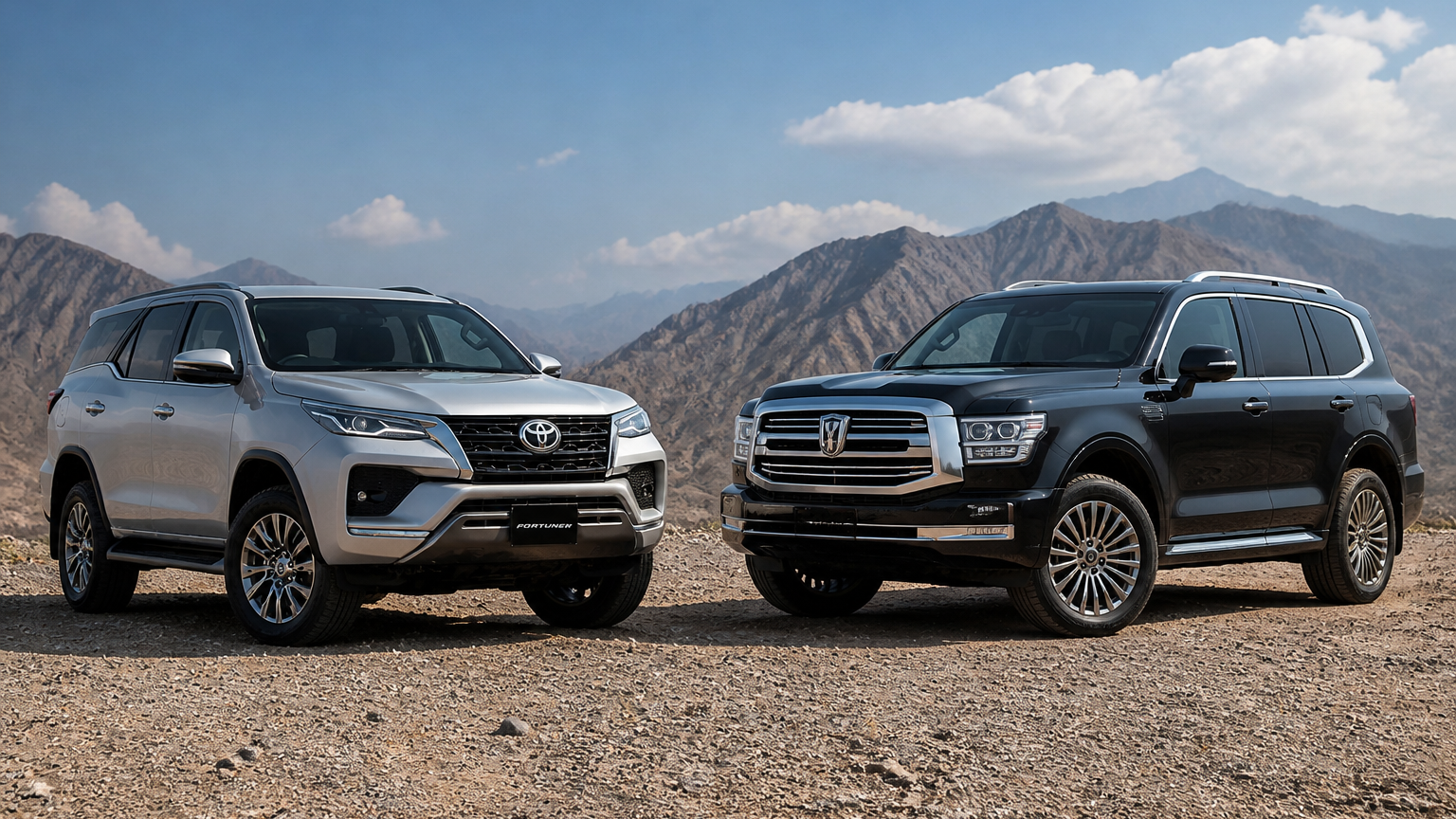
Table of Contents
- Quick comparison
- Toyota Fortuner 2.8 Sigma 4 (2026)
- Price, engine and performance
- Dimensions and practicality
- Tank 500 PHEV (2026)
- Price, engine and performance
- Dimensions and practicality
- Key buying differences
- Which one suits you?
These two 2026 body-on-frame SUVs target different priorities even before equipment is considered. The Toyota Fortuner 2.8 Sigma 4 keeps a conventional diesel 4x4 setup, while the Tank 500 PHEV adds plug-in-hybrid drive, higher output and electric-only range. Their ownership trade-offs are shaped more by powertrain and charging access than by body style alone.
Quick comparison
| Specification | Toyota Fortuner 2.8 Sigma 4 (2026) | Tank 500 PHEV (2026) |
|---|---|---|
| Price | PKR 18,539,000 ex-factory | PKR 22,500,000 ex-factory; PKR 23,909,000 after charges |
| Engine | 2,755 cc 1GD-FTV diesel | 2.0-litre turbo plug-in hybrid |
| Transmission | 6-speed sequential automatic | 9-speed hybrid automatic |
| Drivetrain | 4x4 | 4WD / Hi4-T |
| Body type | Body-on-frame SUV | Body-on-frame SUV |
Toyota Fortuner 2.8 Sigma 4 (2026)
Price, engine and performance
| Specification | Toyota Fortuner 2.8 Sigma 4 (2026) |
|---|---|
| Price | PKR 18,539,000 ex-factory |
| Variant / year | 2.8 Sigma 4, 2026 |
| Engine | 2,755 cc 1GD-FTV diesel |
| Transmission | 6-speed sequential automatic |
| Power | 201 hp (150 kW) |
| Torque | 500 Nm |
| Drivetrain | 4x4 |
| Fuel economy | Reported: 8.5 km/L city; 11 km/L highway; test conditions unconfirmed |
Dimensions and practicality
| Specification | Toyota Fortuner 2.8 Sigma 4 (2026) |
|---|---|
| Body type | Body-on-frame SUV |
| Electric-only range | Not confirmed |
| Total range | Not confirmed |
| Charging | Not confirmed |
The Fortuner 2.8 Sigma 4 stays close to a traditional diesel SUV formula. Its documented package is a 4x4 body-on-frame model with a 1GD-FTV diesel, six-speed sequential automatic and local fuel-economy figures for city and highway use. The main practical limitation is that it offers no electric-only running or charging option.
Tank 500 PHEV (2026)
Price, engine and performance
| Specification | Tank 500 PHEV (2026) |
|---|---|
| Price | PKR 22,500,000 ex-factory; PKR 23,909,000 after charges |
| Variant / year | PHEV, 2026 |
| Engine | 2.0-litre turbo plug-in hybrid |
| Transmission | 9-speed hybrid automatic |
| Power | 402 hp (about 300 kW) |
| Torque | 750 Nm |
| Drivetrain | 4WD / Hi4-T |
| Fuel economy | 2.1 L/100 km, NEDC |
Dimensions and practicality
| Specification | Tank 500 PHEV (2026) |
|---|---|
| Body type | Body-on-frame SUV |
| Electric-only range | 120 km, NEDC |
| Total range | 950 km, NEDC |
| Charging | DC 30% to 80% in 24 min, up to 50 kW |
The Tank 500 PHEV is aimed at buyers who want a more complex but much stronger plug-in package. Its published data point to a 4WD body-on-frame SUV with higher output, substantial torque, NEDC electric range and DC fast-charging support. The trade-off is that its efficiency advantage depends on charging access and hybrid-system use.
Key buying differences
The biggest difference is not just price or equipment; it is the powertrain concept. The Fortuner is a conventional diesel 4x4 with local fuel-use figures and straightforward ownership hardware, while the Tank 500 PHEV is a plug-in hybrid with much higher output, electric-only range and a charging requirement. They suit different operating patterns.
Which one suits you?
As a like-for-like SUV comparison, this is really a diesel-4x4 versus plug-in-hybrid decision. The Fortuner is the more conventional option on paper, while the Tank 500 PHEV delivers the more advanced drivetrain and stronger published performance data. The better choice depends on whether you want established diesel simplicity or the added complexity and range flexibility of a PHEV.
Tags
Share this article
About the Author

Dr Khan
Automotive Expert & Content Strategist
Comments (0)
Login Required
You need to be logged in to comment on this article.
No comments yet. Be the first to share your thoughts!
Related Articles
Chery Tiggo 9 Premium PHEV AWD (2026) vs KIA Sorento 1.6T HEV FWD (2026): Buyer Comparison
User-selected exact DrivePK catalog variants; crossover, model year 2026. Catalog owns the selected identities/year. Research supplies body classification and available specifications. Review before generating blog/social content.
MG HS Hybrid+ (2026) vs Haval H6 HEV (2026): Buyer Comparison
A practical 2026 crossover comparison with a hybrid focus: MG HS Hybrid+ brings documented warranty coverage and a 165 kW combined system, while Haval H6 HEV has clearer Pakistan price evidence and a 240 hp combined hybrid listing. Both are front-wheel-drive crossovers, but the documentation depth differs by area.
Hyundai Elantra 2.0 Limited Edition (Burgundy Interior) (2026) vs Honda Civic Oriel (2026): Buyer Comparison
User-selected exact DrivePK catalog variants; sedan, model year 2026. Catalog owns the selected identities/year. Research supplies body classification and available specifications. Review before generating blog/social content.