Who Participates in Pakistan's EV Expo & Green Mobility Conference 2026 and What They Stand to Gain
Pakistan's EV Expo & Green Mobility Conference 2026 is bringing together ministries, manufacturers, investors, and startups under one roof. Here's who's participating and what every stakeholder stands to gain from this national platform
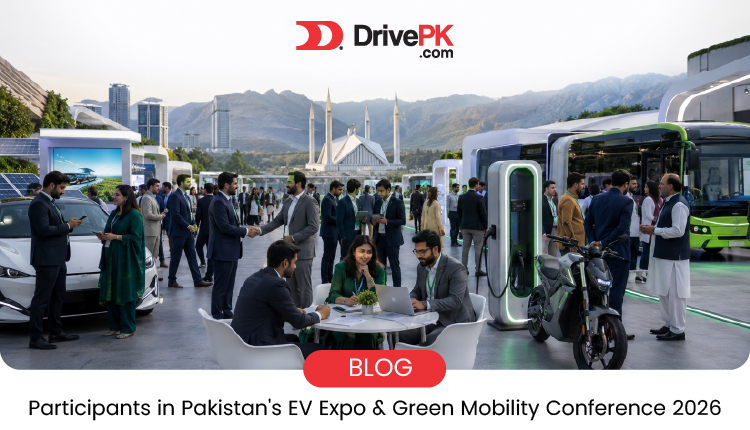
Table of Contents
- The Full Spectrum of EV Ecosystem Participants
- Government Ministries and Regulators
- EV Manufacturers and OEMs
- Energy and Charging Companies
- Financial Institutions and Investors
- Oil Marketing Companies (OMCs)
- Technology Providers and Startups
- Fleet Operators and Logistics Companies
- Academia and Research Institutions
- Expected Outcomes for Participants
- Increased EV Market Visibility
- Capacity Building Across Stakeholders
- New Partnerships and Investments
- Enhanced Industry Readiness
- Strengthened Policy Coordination
- How the Platform Accelerates the Transition from Policy to Market Implementation
Pakistan's transport sector is at a turning point. Cities are choking on smog. The fuel import bill keeps climbing. And somewhere in between the traffic and the policy papers, a question sits: who is actually going to make electric mobility work here?
The EV Expo & Green Mobility Conference 2026, organized by the Pakistan Green Mobility Mission (PGMM), is one serious attempt to answer that. The event runs on 9 to 10 June 2026 at the Pak-China Friendship Center in Islamabad. And unlike a typical trade show, it is not just about displaying new vehicles. It is about pulling every critical player into the same room, at the same time, to do something that has been missing from Pakistan's EV transition so far: to coordinate.
But who exactly is showing up? And what does each stakeholder actually get from being there?
The Full Spectrum of EV Ecosystem Participants
Pakistan's EV challenge is not a single-sector problem. It touches energy infrastructure, financial systems, manufacturing policy, urban planning, and consumer behavior all at once. That is exactly why PGMM built this platform to function as what they call a "convergence mechanism," not a single-ministry event, but a cross-sector gathering.
Here is who is at the table.
Government Ministries and Regulators
The top layer of this conference is the government. Federal ministries involved in PGMM's framework include those overseeing energy, climate change, industries, and transport. Regulatory bodies like NEECA, the National Energy Efficiency and Conservation Authority, are directly tied into the process, particularly around EV charging infrastructure and battery swapping regulations.
Why does this matter? Because Pakistan's New Energy Vehicles (NEV) Policy 2025–2030 already exists on paper. It targets nationwide EV adoption and the deployment of 3,000 charging stations across the country. But according to PGMM's own assessment, implementation has stayed fragmented across institutions. Different ministries, different timelines, no shared coordination layer.
This conference is partly about fixing that. When regulators and federal bodies sit in the same forum as industry and investors, the gap between a written policy and an actual EV on the road gets smaller.
EV Manufacturers and OEMs
Original equipment manufacturers, both domestic assemblers and international brands exploring Pakistan's market are core participants. For them, this event is less about press releases and more about market intelligence.
Pakistan's EV adoption is still low. That is not a surprise, charging infrastructure is thin, financing is limited, and public awareness is patchy. But those are also the exact problems being addressed at this conference. For an OEM considering a local assembly or import strategy, understanding the regulatory direction, the infrastructure rollout plan, and the financing mechanisms that are being put in place is critical. You cannot plan a product line for a market you do not fully understand.
The expo format gives manufacturers direct visibility into buyer segments, into policy intentions, and into the supply chain partners they would need to operate here.
Energy and Charging Companies
Pakistan has a problem that does not get discussed enough in EV conversations: the country already has underutilized power generation capacity. PGMM's framework specifically flags this. The grid has room. What is missing is the last-mile infrastructure of the charging network to make electric vehicles a practical choice outside major urban cores.
Companies working in EV charging, battery swapping, and energy distribution are among the most strategically important participants at this event. NEECA's EV Charging Infrastructure regulations give these companies a clearer legal framework to operate within. The conference is where that regulatory clarity meets private sector interest.
And there is a commercial case here. Pakistan's vehicle parc total registered vehicles on road runs into millions. Even modest EV penetration over the next five years means a significant charging demand. The companies that build the network early capture that demand.
Financial Institutions and Investors
This is the participation that makes or breaks EV transitions in developing markets. Technology can exist. Policy can be written. But without accessible financing, most consumers and fleet operators will not switch.
PGMM's implementation framework directly integrates financial sector institutions, including the State Bank of Pakistan, to build out EV financing mechanisms and improve credit access. Banks, development finance institutions, leasing companies, and private equity investors all have a role defined within the mission's structure.
For financial institutions, the conference answers a practical question: what is the risk profile of EV lending in Pakistan right now? The policy environment, the infrastructure trajectory, and the OEM commitments all of that shapes the risk calculus. Sitting inside this forum, with regulators and manufacturers in the same room, is how you get that clarity.
For investors, particularly those with a clean energy or mobility focus, Pakistan's EV market is early-stage, which means the entry window is still open. PGMM is presenting an investment landscape, not just an exhibition.
Oil Marketing Companies (OMCs)
This might be the most interesting participant category on the list. Oil marketing companies are not typically the first names that come to mind at an EV conference. But their participation here is logical.
Pakistan's heavy dependence on imported petroleum is one of the stated drivers behind the EV push. Reducing that dependency is framed explicitly in PGMM's national context as an economic necessity not just an environmental one. The fuel import bill damages Pakistan's balance of payments.
OMCs face a long-term transition in their core business. The smarter ones are not waiting for disruption. Some are already looking at how forecourt infrastructure can shift toward EV charging services over time. This conference gives them the space to understand the timeline, the policy direction, and where potential partnerships exist.
Technology Providers and Startups
Pakistan's tech ecosystem is not absent from the EV conversation. There is domestic capacity in software, telematics, fleet management systems, and energy management platforms much of it sitting in Lahore, Karachi, and Islamabad's startup corridors.
PGMM's framework does not treat technology as an imported component. Localization and domestic manufacturing are explicit pillars of the mission, with institutions like the Engineering Development Board (EDB) and the Board of Investment (BOI) involved in driving that agenda.
For startups, this conference is a rare chance to get in front of the decision-makers the ministries, the OEMs, the fleet operators who will eventually procure the products they are building. It is not a pitch competition. It is a market access event.
Fleet Operators and Logistics Companies
Fleet operators whether running corporate transport, last-mile delivery, ride-hailing, or public transit have the most direct financial stake in the EV transition. These are the buyers who could shift the market fastest if the economics make sense.
The economics depend on total cost of ownership: upfront vehicle price, fuel savings, maintenance cost, financing terms, and residual value. Right now, that calculation is uncertain for most operators in Pakistan. Charging infrastructure coverage, vehicle availability, and financing options are all still developing.
The conference gives fleet operators a structured way to get ahead of that uncertainty. They can assess vehicle options, understand financing mechanisms, and engage directly with charging companies about coverage in their operating areas. For the logistics sector in particular, where margins are tight and fuel costs are a major line item, the EV transition is not a "nice to have" it is an eventual business necessity.
Academia and Research Institutions
Research institutions are listed as participants in PGMM's institutional scope, and for good reason. Pakistan needs more than imported EV technology. It needs local capacity in battery testing, in grid integration research, in material science, in urban planning for EV infrastructure.
Universities and research organizations attending the conference can engage directly with industry on what practical research priorities look like. It is the difference between academic work that sits in a journal and research that actually feeds into product development or policy design.
PGMM's long-term localization goals reducing import dependence and building a domestic industrial base cannot happen without a research foundation. This is where that foundation starts to form.
Expected Outcomes for Participants
Conferences have a bad reputation for producing great conversations and no follow-through. PGMM is aware of this. The platform is described not as a one-off event but as a coordination mechanism within a phased implementation structure. What participants take away depends on who they are but the outcomes are concrete.
Increased EV Market Visibility
For manufacturers, investors, and technology providers, one of the most valuable things the conference provides is market clarity. Pakistan's EV market is at an early stage where information gaps are a real barrier. What policies are coming? What infrastructure will be in place in two years? What financing instruments will be available?
This event compresses months of one-on-one meetings into two days of structured dialogue. That has a real economic value for any organization trying to plan its Pakistan EV strategy.
Capacity Building Across Stakeholders
PGMM's framework includes awareness and capacity building as a core strategic pillar. For participants particularly from the financial sector, fleet operators, and smaller manufacturers, the conference is a learning environment.
Understanding EV total cost of ownership, battery technology basics, grid compatibility, and charging standards may sound technical, but for a fleet manager or loan officer, these are the building blocks of good decision-making. That knowledge does not exist widely in Pakistan yet. The conference begins to build it.
New Partnerships and Investments
The platform is specifically designed to enable partnerships and investment opportunities. This is not just language. When an EV charging company is in the same room as a logistics fleet operator who has fifty trucks and a fuel bill problem, the conditions for a commercial agreement exist.
When a development finance institution is in the same panel as a domestic EV assembler looking for working capital, a financing structure can start to take shape. These connections do not happen automatically. But the conference creates the conditions for them.
Enhanced Industry Readiness
Pakistan's EV industry, particularly the domestic manufacturing and assembly side, is not fully ready to scale. Component sourcing, quality standards, after-sales networks, and technical training are all still developing. Industry readiness is an outcome that takes time, but the conference accelerates it.
When manufacturers engage with regulators on standards, when assemblers talk to parts suppliers about localization, when training institutions hear directly from OEMs about skill gaps, that is the groundwork for an industry that can actually grow.
Strengthened Policy Coordination
This is perhaps the most important expected outcome, and it is the one most specific to PGMM's mandate. Pakistan does not lack EV policy. The NEV Policy 2025–2030 is there. The climate commitments are there. The Alternative and Renewable Energy Policy is there.
What has been missing is execution. PGMM's diagnosis of the problem is clear: fragmented institutional coordination has slowed the transition. The conference is where that coordination starts to happen in practice with federal ministries, provincial governments, regulators, and industry in direct dialogue.
When a regulator understands what an OEM needs in terms of standards timelines, and an OEM understands what charging infrastructure will be available and when, both can plan better. Better planning means faster execution.
How the Platform Accelerates the Transition from Policy to Market Implementation
Pakistan is not the first country to face the gap between a national EV policy and actual vehicles on the road. That gap is almost universal, and it has a consistent set of causes: institutional silos, financing barriers, infrastructure lags, and low consumer awareness.
PGMM's implementation framework maps these directly. It outlines three phases: Phase I covers institutional alignment and pilot interventions. Phase II moves to infrastructure scale-up and market activation. Phase III targets system integration and nationwide adoption.
The EV Expo & Green Mobility Conference 2026 sits at the opening of Phase I. Its job is not to build charging stations or approve loans. Its job is to align the institutions and actors that will do those things, so that when Phase II begins, the coordination infrastructure is already in place.
Think of it this way. Pakistan has 3,000 charging stations to deploy under the NEV Policy target. That requires land, power connections, technical standards, private investment, and operational management. Each of those involves a different set of actors. If they do not have a shared understanding of the plan, the timelines, and each other's roles, the target stays on paper.
The conference creates that shared understanding. Not perfectly. Not all at once. But the policy-to-market gap in EV transitions is not usually a technology problem, nor even a financing one. It is a coordination problem. And coordination starts with conversations in rooms where everyone who matters is actually present.
Pakistan's EV transition is not going to happen because a policy was written. It is going to happen because the right people, manufacturers, financiers, regulators, infrastructure companies, fleet operators, and researchers decide to move together. That is harder than it sounds.
The EV Expo & Green Mobility Conference 2026 is one serious attempt to make it happen. Whether it succeeds depends on what participants do with the connections and clarity they gain there.
But the people who need to be in the room will be there. That part, at least, is sorted.
For more information or registration, contact PGMM at 0335 777 7466 or visit the PGMM Contact Center.
Tags
Share this article
About the Author

Najeeb Khan
Automotive enthusiast and writer
Comments (0)
Login Required
You need to be logged in to comment on this article.
No comments yet. Be the first to share your thoughts!
Related Articles

Jhang Desert Rally 2026 Set for October 16–18
Jhang may host its first desert rally and cultural festival Oct 16–18, 2026, featuring a 95km Thal Desert course and 100 racers.
New Electric Scooters at PAPS 2026: Prices, Range & Specs
PAPS 2026 brought 14 new electric scooters from OKLA and EcoDost, with prices from Rs 199,000 to Rs 699,000. This guide lists every model with motor, battery, speed and claimed range, then shows what real riders should expect, what running costs look like and what to check before you book.
PAPS 2026: New Vehicle Launches & Reveals at Pakistan Auto Show
PAPS 2026 in Lahore brought new car reveals from Chery, Suzuki, Haval, Kia, Hyundai, Jaecoo, BYD and GWM. Here's every model shown, with confirmed prices where available and full specs for the rest.