Changan Nevo Hunter vs BYD Shark 6 Comparison
Two Chinese hybrid pickups now compete for buyers who want electric drive without range anxiety. The Changan Nevo Hunter uses a pure range-extender setup. The BYD Shark 6 is a parallel plug-in hybrid. Here is a clear, numbers-based comparison of power, payload, range, towing and daily usability so you can decide which one fits your work and budget.
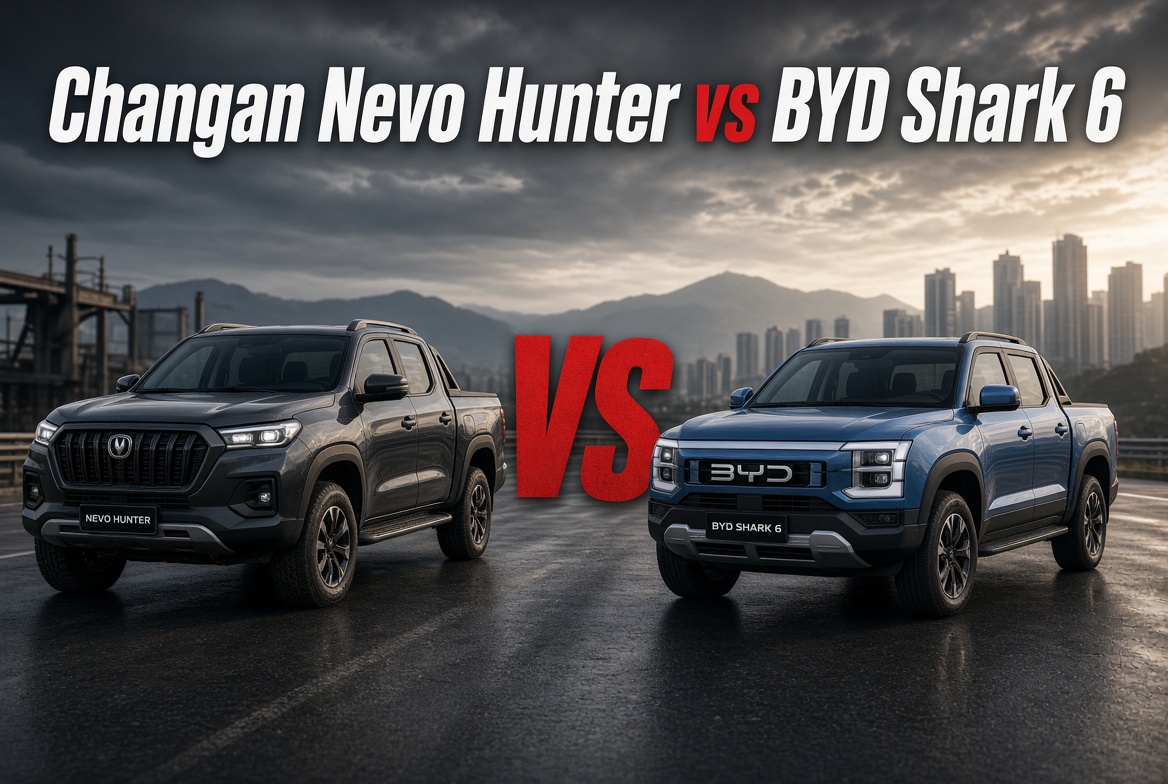
Table of Contents
- How the Powertrains Differ
- Head-to-Head Spec Comparison
- Range and Real-World Running Costs
- Capability: Payload, Towing and Off-Road
- Cabin, Tech and Everyday Feel
- Price and Ownership
- Which One Should You Choose?
You want a dual-cab that saves fuel, still tows, and does not leave you stranded when the battery runs low. Two new Chinese options now sit on the table: the Changan Nevo Hunter and the BYD Shark 6. Both are hybrid pickups. Both claim long range. Both look modern. But they work in different ways, and the differences matter once you start loading them or driving long distances.
This is not a sales pitch. It is a straight look at the numbers, the engineering choices, and what those choices mean in daily use.
How the Powertrains Differ
The biggest split is under the skin.
The Changan Nevo Hunter is a range-extender electric vehicle (REEV). A 2.0-litre turbo petrol engine sits under the bonnet, but it never drives the wheels. It only spins a generator that charges the battery or feeds the electric motors. The wheels are driven only by electric motors all the time. In South African and many export specs the system makes about 200 kW and 470 Nm. In some markets the figures are listed higher, around 268 hp. Battery size is 31.18 kWh (LFP). Claimed pure-electric range sits between 131 km (NEDC) and 145 km (CLTC). Combined range with a full 70-litre tank reaches up to 1,000–1,031 km depending on the test cycle.
The BYD Shark 6 is a parallel plug-in hybrid (PHEV) that uses BYD’s DMO system. A 1.5-litre turbo petrol engine can drive the wheels directly when needed. Two electric motors (one front, one rear) add power. Combined output is 321 kW and 650 Nm in the main Premium version. Battery is 29.58–29.6 kWh (BYD Blade LFP). Pure-electric range is about 85 km WLTP or 100 km NEDC. Combined range is listed at around 670 km WLTP or up to 800 km NEDC. Fuel tank is 59–60 litres. 0–100 km/h takes a claimed 5.7 seconds.
In short: the Hunter feels like a pure electric truck that can keep going on petrol. The Shark 6 feels more like a powerful hybrid that can also run electric for shorter trips.
Head-to-Head Spec Comparison
| Spec | Changan Nevo Hunter (REEV) | BYD Shark 6 Premium (PHEV) |
|---|---|---|
| Powertrain | Series hybrid (engine = generator only) | Parallel hybrid (engine can drive wheels) |
| Engine | 2.0L turbo petrol | 1.5L turbo petrol |
| Combined power / torque | ~200 kW / 470 Nm | 321 kW / 650 Nm |
| Battery | 31.18 kWh LFP | 29.58–29.6 kWh LFP |
| Pure electric range | Up to 145 km (CLTC) / 131 km (NEDC) | Up to 100 km (NEDC) / 85 km (WLTP) |
| Combined range | Up to 1,000–1,031 km | Up to 670–800 km |
| Fuel tank | 70 L | 59–60 L |
| 0–100 km/h | ~7.9 s | 5.7 s |
| Payload | Up to 1,000 kg | 790–835 kg |
| Braked towing | ~2,200 kg | 2,500 kg (3,500 kg on Performance) |
| Ground clearance | 220 mm | 230 mm |
| Length / wheelbase | ~5,380 mm / 3,180 mm | 5,457 mm / 3,260 mm |
| Typical pricing (SA example) | From ~R799,900 | From ~R969,900–R989,900 |
Figures vary slightly by market and exact trim. The table uses the most commonly published export and South African numbers.
Range and Real-World Running Costs
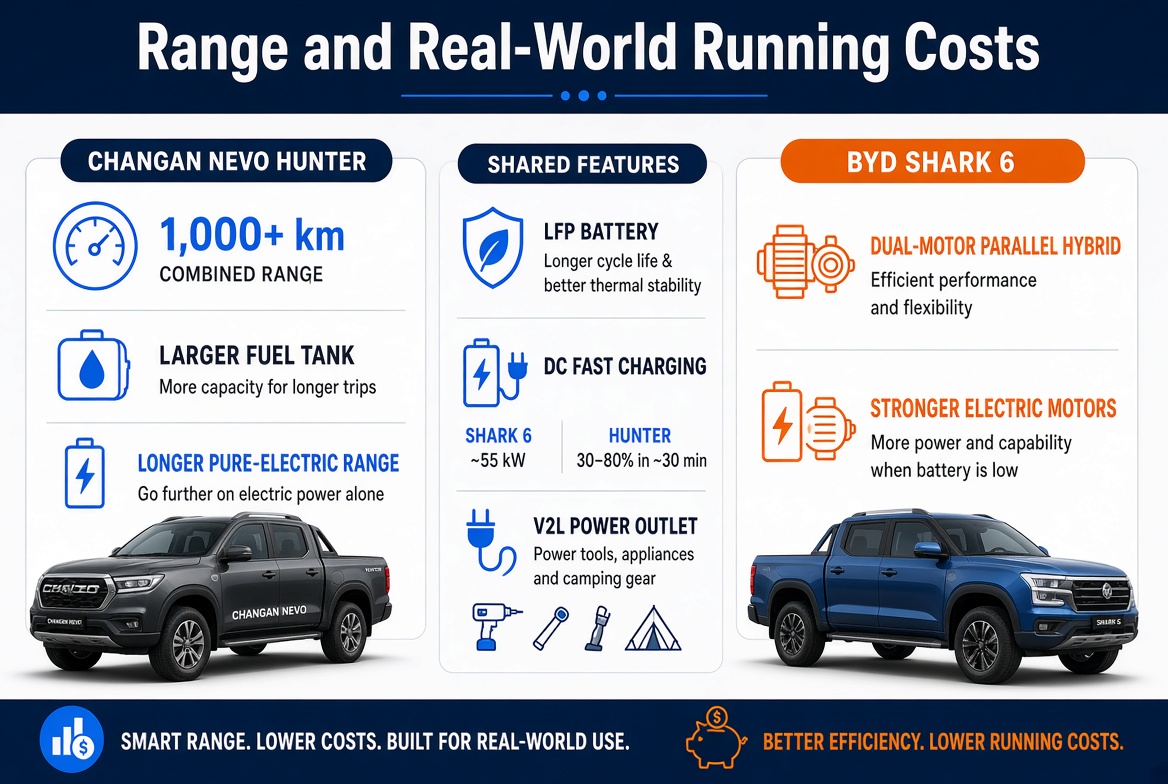
Range is where the Hunter often pulls ahead on paper. The larger fuel tank and longer pure-electric figure give it a claimed combined range that stretches past 1,000 km. That matters if you cover long distances between fuel stops or charging points. The Shark 6’s combined figure is lower, but its stronger electric motors and parallel setup can feel more efficient when the battery is low and the petrol engine is working hard.
Both use LFP batteries, which are known for longer cycle life and better thermal stability than older nickel-based packs. Both support DC fast charging (Shark 6 up to about 55 kW; Hunter around 30 minutes for 30–80 % in many markets). Both offer vehicle-to-load (V2L) power so you can run tools or camping gear from the truck.
Fuel use numbers are claimed and will change with load, speed, terrain and how often you charge. Expect the Hunter to stay closer to pure-electric feel for longer. Expect the Shark 6 to feel stronger once the petrol engine joins in.
Capability: Payload, Towing and Off-Road
If you regularly carry close to a tonne, the Hunter’s higher payload rating is useful. The Shark 6 trades some payload for higher peak power and a higher towing figure in most markets (2,500 kg standard, 3,500 kg on the Performance version). Ground clearance is similar, with the Shark 6 a little higher. Approach and departure angles favour the Shark 6 in published figures.
Neither is a hardcore rock-crawler. Both sit more in the lifestyle-plus-work category. Multiple drive modes (Eco, Sport, Snow, Mud, Sand, etc.) are available on both. The Hunter’s pure electric drive gives smooth, instant torque everywhere. The Shark 6’s higher total output makes it the quicker vehicle in a straight line and under load.
Cabin, Tech and Everyday Feel
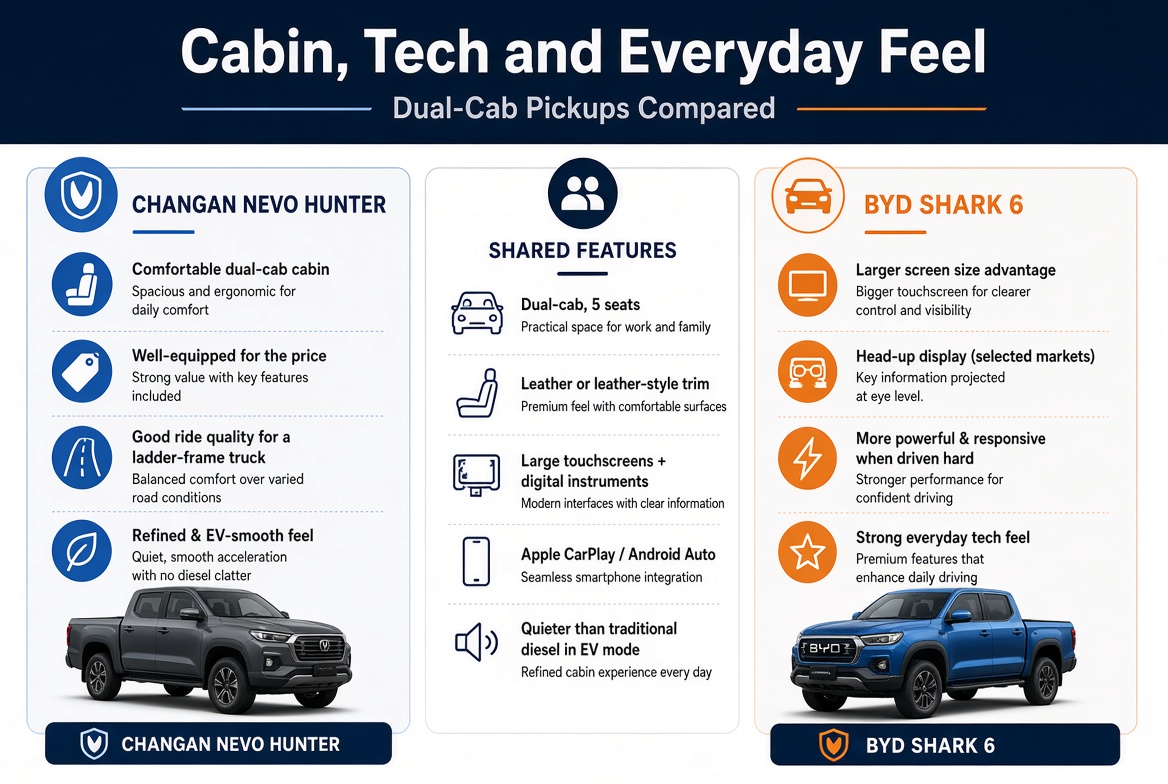
Both trucks offer dual-cab layouts with five seats, leather or leather-style trim, large touchscreens, digital instruments, and the usual connectivity (Apple CarPlay / Android Auto on most trims). The Shark 6 often gets the edge on screen size and some higher-end features such as a head-up display in certain markets. The Hunter’s cabin is described as comfortable and well-equipped for the price, with good ride quality for a ladder-frame truck.
Ride and handling notes from early reviews point to the Hunter feeling refined and EV-smooth. The Shark 6 feels more powerful and responsive when driven hard. Neither is as quiet as a pure electric car once the engine is running, but both are quieter than a traditional diesel dual-cab in electric mode.
Price and Ownership
In markets where both are sold side by side, the Hunter usually undercuts the Shark 6 by a noticeable margin. That price gap is one of the main reasons many buyers look at the Changan first. Warranty cover varies: typical figures are five or six years on the vehicle and eight years on the battery, with exact terms depending on the country.
Service networks are still growing for both brands outside China. Check local dealer coverage and parts availability before deciding. Running costs should favour either truck over a pure diesel dual-cab if you charge regularly and keep the battery topped up.
Which One Should You Choose?
Pick the Changan Nevo Hunter if you want the longest claimed range, higher payload, a smoother pure-electric driving feel, and a lower entry price. It suits buyers who travel far between stops or carry heavy loads often.
Pick the BYD Shark 6 if maximum power, quicker acceleration, higher towing capacity, and BYD’s established hybrid experience matter more. It suits buyers who want the strongest performance in the class and can accept a bit less payload and range.
Both trucks show how quickly Chinese manufacturers have moved into the hybrid dual-cab space. They are not identical. The powertrain difference is real and shapes how each vehicle behaves every day. Look at your actual distances, typical loads, and budget. Then drive both if you can. The numbers above give you the starting point. For more updates, visit DrivePK.com
Tags
Share this article
About the Author

Najeeb Khan
Automotive enthusiast and writer
Comments (0)
Login Required
You need to be logged in to comment on this article.
No comments yet. Be the first to share your thoughts!
Related Articles
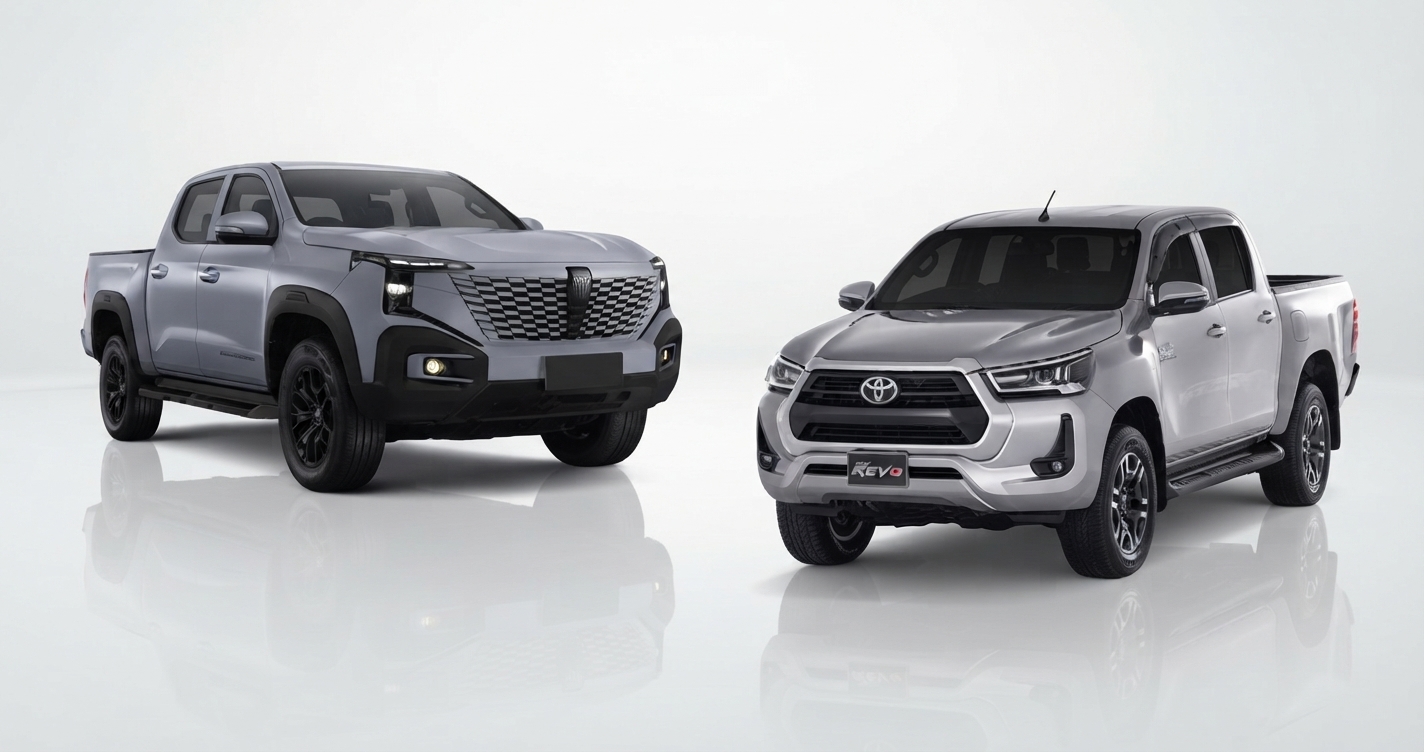
Changan Nevo Hunter vs Toyota Revo V: Mind blowing Comparison
The Changan Nevo Hunter brings range-extender electric power to Pakistan’s pickup market and challenges the long-reigning Toyota Revo V. Here is a clear side-by-side look at power, size, price, off-road ability and which truck fits different buyers.
iCAUR V23 vs iCAUR V27: A Clear Comparison for Pakistani Buyers
The iCAUR V23 is a pure electric compact SUV with dual-motor power and 430 km range. The larger V27 uses a 1.5-litre range extender for nearly 1,000 km total range and stronger performance. Both offer modern screens, safety systems and boxy off-road styling suited to Pakistani roads and buyers.