The Rs 107 Levy Trap: How Pakistan's Petrol Pump Became the World's Stealthiest Auto Tax Machine
Pakistan's petroleum levy target for FY27 stands at Rs 1.727 trillion, exceeding both active IMF loan programmes combined. But nobody calls it a car tax. Every fortnightly OGRA revision quietly extracts tens of thousands from ordinary drivers, while headlines celebrate Rs 4 relief. Here's what's actually happening at the pump.
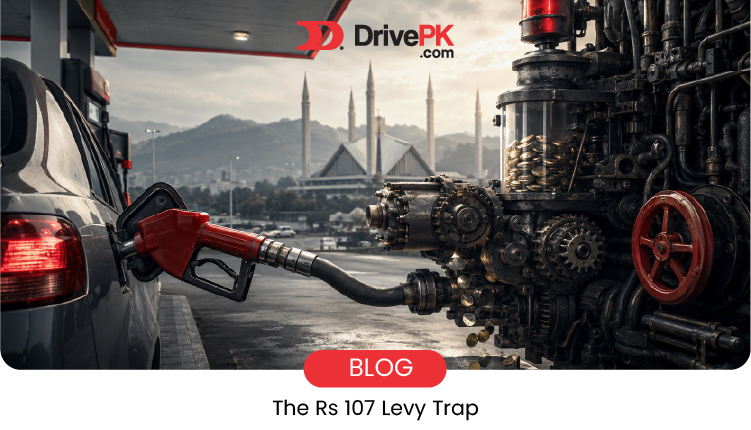
Table of Contents
- What You Actually Pay For at the Pump
- The Arithmetic Nobody Is Running for You
- Run the numbers on a typical 1,200cc hatchback owner in Lahore:
- Rs 1.727 Trillion: A Number Too Big to Ignore
- Pakistan collected more from the petroleum levy in two years than it received in emergency IMF loans.
- The IMF Clause You Didn't Vote On
- The April Shock and What It Revealed
- The PDL hit Rs 160/litre. The pump price hit Rs 458.
- Diesel and the Urban-Rural Divide Nobody Talks About
- Compare that to petrol: Rs 127.22/litre in PDL and customs duty combined.
- The Inflation Cascade You Feel but Can't Calculate
- The channel isn't complicated:
- Budget 2026-27: What's New and What Was Missed
- What Comes Next: Predictions Worth Tracking
- The Real Question: Who Pays Pakistan's Fiscal Crisis?
- The Fortnightly Tax Bill You Never See
- Almost nobody talks about what's inside that number.
- Frequently Asked Questions
- What is the petroleum development levy in Pakistan?
- Why did petrol hit Rs 458/litre in April 2026?
- Does the petroleum levy go to provinces?
- What is Pakistan's FY27 petroleum levy target?
- How does the petroleum levy affect inflation?
- Can the government raise the levy without parliament's approval?
On the night of April 3, 2026, Petroleum Minister Ali Pervaiz Malik walked up to a microphone and announced what would become the single largest petrol price hike in Pakistan's recorded history.
Petrol jumped from Rs 321.17 to Rs 458.41 per litre in one notification. Overnight. A Rs 137.24 increase, more than the entire price of a litre of petrol in 2007.
Less than 36 hours later, Prime Minister Shehbaz Sharif was on national television announcing Rs 80 "relief."
The headlines called it a victory. Petrol "slashed" to Rs 378. People exhaled.
But here's what nobody said out loud: the PM didn't cut the oil price. He cut the petroleum levy, the government's own fixed tax on fuel. And when he cut it by Rs 80, the levy still stood at over Rs 80 per litre. The government had briefly charged Rs 160/litre in its own tax on a single product, then "relieved" you of half of it and called it a gift.
That tells you everything about how Pakistan's pump price really works.
What You Actually Pay For at the Pump
Most people think petrol is expensive because oil is expensive. That's partially true. But Pakistan's pump price is stacked, layer by layer, like a tax sandwich with crude oil somewhere in the middle.
OGRA's formula adds: international crude cost, port and import charges, inland freight equalisation margin (IFEM), OMC (oil company) margin, dealer commission, petroleum levy, and sales tax.
Here's what each layer looked like as of early May 2026, when total taxes and margins on petrol stood at over Rs 153 per litre:
- Ex-refinery price (the actual oil cost): ~Rs 246/litre
Then the government and supply chain stack on top:
- Petroleum Development Levy (PDL): Rs 103–117/litre (the biggest variable)
- Customs Duty: ~Rs 27/litre on petrol
- Climate Support Levy: Rs 2.50/litre
- IFEM (Inland Freight Equalisation Margin): Rs 4–6/litre
- OMC Margin: ~Rs 7.87/litre
- Dealer Commission: ~Rs 8.64/litre
- GST/Sales Tax: Currently 0% suspended since 2022
Before the April 2026 Middle East crisis, taxes, duties, and margins on petrol stood at Rs 107.12 per litre, accounting for 42% of the total cost.
Think about that. You fill a 40-litre tank. Rs 4,285 goes into it. Around Rs 1,700 of that is government charges, not oil.
And the PDL? That's the one that matters most. The PDL was further increased to Rs 117.41 as of May 9, 2026, bringing total petrol to Rs 414.78. This levy alone now takes up almost 28% of the total price per litre.
Nearly a third of your pump bill is one government charge. Not a market price. Not crude oil. A tax.
The Arithmetic Nobody Is Running for You
Pakistan doesn't have an annual car ownership tax like many countries do. There's no road user levy billed to your address once a year. What Pakistan has instead is a fortnightly fuel tax — collected quietly, every time you fill up, buried inside a price you've been conditioned to accept as "international oil prices."
Run the numbers on a typical 1,200cc hatchback owner in Lahore:
- Monthly fuel consumption: ~80–100 litres (typical urban commuter)
- Petroleum levy component per litre: ~Rs 107 (pre-April 2026 baseline)
- Monthly levy paid: Rs 8,560 – Rs 10,700
- Annual levy paid: Rs 102,720 – Rs 128,400
That's Rs 100,000+ per year in a single government charge embedded in fuel that never shows up on any tax bill, never gets debated in a parliamentary session, and never appears in your income tax return.
For a motorcyclist doing 30 km daily — Pakistan's most common commuter — the story is just as stark. A motorcycle averaging 40 km/litre covering 30 km per day costs approximately Rs 295 per day or Rs 8,850 per month in petrol at Rs 393.35/L. At a levy of Rs 107/litre, over Rs 2,600 of that monthly fuel bill is just the PDL.
For freight operators running diesel trucks? The numbers multiply fast. And freight costs don't stay with the truck owner. They pass to the goods. And the goods pass the cost to you.
Rs 1.727 Trillion: A Number Too Big to Ignore
Here's the figure that should be in every headline but somehow isn't.
Pakistan's petroleum levy target for FY2026-27 is Rs 1.727 trillion, approximately Rs 292 billion higher than the current fiscal year's benchmark.
To put that in context: From April 2024 to March 2026, petroleum levy collections stood at Rs 2,725 billion, an amount that exceeds the combined size of Pakistan's two ongoing IMF loan programmes in rupee terms. The total value of both IMF programmes during that period was approximately Rs 2,340 billion.
Pakistan collected more from the petroleum levy in two years than it received in emergency IMF loans.
Nobody called it a crisis. Nobody held parliamentary hearings. Because it's not classified as a tax.
The IMF has set Pakistan's petroleum levy collection target for FY27 at Rs 1.727 trillion and tightened revenue conditions for the FBR. The levy target represents a 17.6% increase over the current year's target agreed to, quietly, as part of Pakistan's ongoing IMF programme obligations.
And here's the thing about the timing: during the first eleven months of the fiscal year (July to May), petroleum levy collections reached Rs 1.43 trillion. An additional Rs 140 billion is expected in June, which could take total receipts to around Rs 1.57 trillion by the end of the fiscal year, roughly Rs 100 billion above the original target.
The government didn't just meet its levy target. It blew past it.
The IMF Clause You Didn't Vote On
Here is where this stops being just a fuel story.
The petroleum levy is classified in Pakistan's fiscal framework as non-tax revenue. That classification is doing a lot of heavy lifting and not in your favour.
The petroleum levy has become a permanent revenue extraction instrument functioning exactly like a tax but without constitutional safeguards applicable to taxation. The constitutional contradiction is glaring: the federation insists petroleum levy is not a tax whenever provincial sharing is discussed, but treats it exactly like a tax for budgetary and revenue purposes.
Because it's technically "non-tax revenue," it doesn't get shared with provinces under the National Finance Commission (NFC) Award, the constitutional mechanism that distributes federal revenues. Every rupee of the Rs 1.727 trillion levy stays with the federal government, not the provinces where most roads are built and used.
And because it's non-tax revenue, it bypasses the standard parliamentary tax debate. Under the Finance Act 2025, the executive effectively acquired extraordinary flexibility to raise the Petroleum Levy beyond previously understood limits. Critics argue this undermines parliamentary sovereignty because taxation authority fundamentally belongs to the people through their elected representatives.
The levy can be raised and has been raised through an executive notification. A Statutory Regulatory Order (SRO). No budget debate. No vote. No parliamentary approval required.
Jamaat-i-Islami's emir has approached the Federal Constitutional Court, challenging the petroleum levy framework, arguing that the federal government has given itself sweeping authority to impose fiscal burdens through executive notifications without parliamentary oversight. The petition argues the arrangement is ultra vires and violates multiple articles of the Constitution.
The court challenge is still pending. Meanwhile, the levy keeps climbing.
The April Shock and What It Revealed
The April 3, 2026, hike was exceptional in scale, but it wasn't exceptional in mechanism. It just made the mechanism visible.
The federal government increased the Petroleum Development Levy on petrol by Rs 55 on April 3, 2026, to Rs 161 per litre. The manipulation pushed the retail price of petrol to Rs 458.41 per litre, an increase of Rs 137 in a single announcement.
Global crude prices spiked. Iran closed the Strait of Hormuz. Brent hit $131. But Pakistan had also been absorbing rising prices since February, building up a Rs 129 billion subsidy bill it couldn't sustain. When the cap broke, it broke hard.
The PDL hit Rs 160/litre. The pump price hit Rs 458.
Within 36 hours, the PM announced Rs 80 relief. The media celebrated. But what actually happened was the government temporarily cut its own levy, not the oil price, from Rs 160 down to around Rs 80. The oil price hadn't changed. The "relief" was the government choosing to collect slightly less of its own tax, briefly.
The government cited Rs 129 billion in accumulated fuel subsidies absorbed since February 2026, alongside Brent crude at $131.40 per barrel and the IMF's refusal to extend further fiscal space.
This is the architecture in plain view. The IMF sets a floor on levy revenue. The government collects to that floor. When oil prices spike, the levy spikes with them (or the subsidy bill becomes unsustainable and gets passed on). When oil prices fall, the levy is quietly raised to maintain the collection target. The consumer doesn't win either way.
Diesel and the Urban-Rural Divide Nobody Talks About
There's a layer of asymmetry in Pakistan's fuel taxation that rarely gets reported.
Diesel is Pakistan's agricultural and freight fuel. Tractors, trucks, and irrigation pump sets all run on HSD. The political cost of taxing diesel at the same rate as petrol is higher because the farming lobby is real and rural income is politically sensitive.
The government collects Rs 82.81 per litre from HSD consumers on account of petroleum levy, climate support levy, and customs duty. Customs duty of Rs 51.62 per litre, petroleum levy of Rs 28.69, and climate support levy at Rs 2.50 per litre are being charged on high-speed diesel.
Compare that to petrol: Rs 127.22/litre in PDL and customs duty combined.
So urban car owners and motorcyclists cross-subsidise the diesel-dependent supply chain and the agriculture sector. The political calculation is that city-dwellers complain less effectively than farmers. And the IMF, primarily interested in aggregate levy revenue, doesn't dictate the petrol-diesel split.
The result: your Lahore or Karachi commute bears a disproportionate share of Pakistan's fuel tax burden. The truck bringing vegetables to your neighbourhood pays far less per litre in government charges but passes its own logistics costs to you anyway, just through a different line item.
The Inflation Cascade You Feel but Can't Calculate
Every Rs 10/litre increase in fuel adds 0.3 to 0.5 percentage points to CPI within 4–6 weeks. Transport accounts for 8 to 15% of food cost. Shopkeepers report delivery trips rising from Rs 1,000 to Rs 3,000.
The March 7, 2026, hike of Rs 55/litre alone was projected to add 1.5–2.5 percentage points to headline inflation. Then April added Rs 137 more in a single night.
The channel isn't complicated:
- Fuel gets more expensive.
- Freight operators raise rates immediately.
- Manufacturers and distributors adjust their pricing.
- Retailers pass the increase to consumers often with a margin on top.
- CPI goes up. Real wages go down.
And because the petroleum levy is a fixed per-litre charge rather than a percentage, it doesn't fall when oil prices fall. It stays. The March 2026 baseline levy of Rs 84/litre didn't drop when international crude softened — it went up to Rs 105, then Rs 117.
It is the common people who are affected by the burden of high fuel prices, mostly transport-dependent people such as motorcyclists, truck operators, and rickshaw drivers. These price increases are passed on to the economy, raising freight rates and the prices of basic commodities such as food, vegetables, and medicines.
This is the inflation that doesn't get attributed to taxation in CPI breakdowns. It shows up as "food prices" or "transport costs." The fuel levy hides inside those categories, untraceable to a single line in the budget.
Budget 2026-27: What's New and What Was Missed
The budget proposes the introduction of an Environmental Levy on luxury vehicles: 10% on petrol and diesel vehicles with engine capacities between 2001cc and 3000cc, and 19.5% on vehicles exceeding 3000cc. The government expects to generate approximately Rs 25.8 billion through Environmental Levy collections on vehicles above 2000cc.
This is new and worth watching. Pakistan is formalising vehicle-based environmental taxation on top of the existing fuel levy structure. For now, it targets larger vehicles. But it signals the direction: more layers on top of existing layers.
What wasn't done is equally important. The government missed two structural changes that independent economists have been pushing for years:
- Delinking the levy from the oil price cycle. Right now, when oil prices rise sharply, the government has two bad options: absorb a massive subsidy bill or pass a massive hike to consumers. A pre-announced, gradual levy increase schedule known in advance would smooth this volatility and allow businesses to plan. It wasn't introduced.
- Broadening the tax base instead of deepening fuel extraction. Pakistan's 18% standard GST rate is not low by regional standards, but barely one-quarter of the theoretical base is taxed. A broad set of basic goods remains exempt or concessionally taxed.
The petroleum levy is the path of least resistance, collected at a handful of refineries and import terminals, not from millions of businesses and individuals. Fixing the GST base would generate comparable revenue with less economic distortion. It's also much harder politically.
The FY27 budget chose the easier path. Again.
What Comes Next: Predictions Worth Tracking
- A mid-year SRO if FBR misses its target. The IMF has now converted the FBR's Rs 15.27 trillion collection target into a quantitative performance criterion, meaning that if the FBR fails to meet the agreed benchmark, Pakistan will need a waiver from the IMF executive board. If FBR collections fall short as they have for the past two consecutive years, expect a quiet petroleum levy increase via SRO, without a budget debate.
- The climate support levy is set to grow. Currently at Rs 2.50/litre, the climate support levy is a small but formalised entry point for what could become a carbon pricing mechanism. Multiple fiscal analysts and IMF documents point toward this expanding to Rs 10–20/litre by FY2028-29, possibly faster if Pakistan pursues climate finance commitments.
- Continued diesel asymmetry. The petrol-diesel levy gap will likely widen, not narrow. Agricultural and freight lobbies are politically stronger than urban commuters, and the IMF doesn't specify the split — only the total.
- The constitutional challenge outcome. The JI petition in the Federal Constitutional Court could, if successful, force the government to either pass levy increases through parliament or reclassify the levy as a tax (triggering NFC sharing obligations). Either outcome would fundamentally change how this revenue is raised and distributed.
The Real Question: Who Pays Pakistan's Fiscal Crisis?
Pakistan's public debt is around 70% of GDP. A major portion of the budget, Rs 7,824 billion, is likely to be allocated for debt servicing, underscoring continued pressure from interest payments on public debt.
Revenue has to come from somewhere. The IMF is right that Pakistan needs more of it. The argument isn't whether to collect Rs 1.727 trillion in FY27. The argument is about how it's collected, from whom, and whether those who collect the revenue are accountable to those who pay it.
Right now, Pakistan's richest individuals, real estate empires, and large agricultural landowners contribute a fraction of what their wealth suggests they should. The agricultural income tax regime, despite years of IMF pressure, still hasn't taken off. The property sector remains under-taxed.
Meanwhile, a daily-wage worker on a motorcycle filling 10 litres a fortnight pays Rs 1,070 in PDL alone with no deduction, no exemption, no rebate.
For a daily-wage worker riding 30 km to work and back, the difference between Rs 74 per litre (June 2020) and Rs 377.81 per litre (June 2026) is not an abstraction.
In six years, the pump price has risen over 5x. The petroleum levy alone — which was near-zero in 2018 — now exceeds Rs 107 per litre at its pre-crisis baseline and has touched Rs 161 at its peak.
This is not an energy policy. It's a regressive tax policy dressed in OGRA notifications.
The Fortnightly Tax Bill You Never See
Every 15 days, OGRA releases a notification. The media runs the headline: price up, price down, relief announced, hike absorbed. The conversation is always about the total number at the pump.
Almost nobody talks about what's inside that number.
Pakistan taxes its car-owning and fuel-consuming population silently, fortnightly, at the pump. The levy bypasses the NFC, bypasses parliament, and bypasses provincial consultation. It is agreed in Islamabad, sometimes in Washington, and implemented via SRO.
The federation is no longer interested in broadening the tax base or reforming elite privileges. Instead, it has discovered an easier path.
You fill your tank. Rs 107+ goes to the government before a single rupee reaches the oil company. Your grocery delivery costs more. Your ride-hailing fare goes up. Your school van charges climb.
And every fortnight, the cycle resets.
The real budget line isn't in the finance minister's speech. It's printed on the OGRA notification in fine type, under "Petroleum Development Levy." For more updates, visit DrivePK.com
Frequently Asked Questions
What is the petroleum development levy in Pakistan?
The PDL is a fixed per-litre government charge on petroleum products. It is classified as non-tax revenue, meaning it doesn't get shared with provinces and doesn't require parliamentary approval to raise. As of mid-2026, it stands at approximately Rs 78–107/litre on petrol, depending on the notification period.
Why did petrol hit Rs 458/litre in April 2026?
A combination of factors: Iran's closure of the Strait of Hormuz pushed Brent crude above $130/barrel, Pakistan had accumulated Rs 129 billion in unrecovered subsidies since February, and the IMF had refused to extend further fiscal space. The PDL was simultaneously raised to Rs 161/litre, compounding the impact.
Does the petroleum levy go to provinces?
No. The PDL is non-tax revenue and falls outside the NFC Award distribution framework. All collections go directly to the federal government. This is a major constitutional dispute — Jamaat-i-Islami has filed a petition in the Federal Constitutional Court challenging the arrangement.
What is Pakistan's FY27 petroleum levy target?
Rs 1.727 trillion, a 17.6% increase over the current year's target of Rs 1.468 trillion, set by the IMF as part of Pakistan's EFF programme conditions.
How does the petroleum levy affect inflation?
Every Rs 10/litre fuel price increase adds approximately 0.3–0.5 percentage points to the CPI within 4 to 6 weeks. This flows through freight costs, food prices, and transport fares, affecting even those who don't own vehicles.
Can the government raise the levy without parliament's approval?
Currently, yes. Through a Statutory Regulatory Order (SRO), the executive can raise the PDL.
Tags
Share this article
About the Author

Najeeb Khan
Automotive enthusiast and writer
Comments (0)
Login Required
You need to be logged in to comment on this article.
No comments yet. Be the first to share your thoughts!
Related Articles
Geely to Launch 3 SUVs in Pakistan
Geely is set to enter Pakistan with two electric SUVs and a hybrid, imported by Bestway Automotive—but models, prices and launch dates remain unknown.
GWM Hybrid Prices Held in Pakistan for Now
GWM reportedly keeps hybrid prices unchanged in Pakistan—for now. Buyers should get a dated dealer quote and verify terms before booking.
Auction Sheet vs Inspection: Need Both in Pakistan?
An auction sheet shows a Japanese import’s past; a physical inspection reveals its condition today in Pakistan. Know the difference before you buy.