Tyre Tax in Pakistan Budget 2025-26: Higher Grocery Prices
Pakistan’s tyre duties and anti-dumping measures in Budget 2025-26 raise truck operating costs, pushing freight rates and everyday prices higher.
Table of Contents
- 96 Percent of Pakistan's Goods Move on Four Wheels and Twelve Tyres
- What the Budget Actually Did and What It Did Not Say
- The Transmission Chain: From Tyre to Table
- The Cold Chain Problem: Agri-Perishables Take the Hardest Hit
- Why General Tyre Benefits and Why That Is a Problem Worth Examining
- The Numbers: What Rs 5,000 to Rs 12,000 Per Tyre Actually Means at Scale
- The Retreading Question: The Road Not Taken in This Budget
- The Smuggling Surge: What Happens Next
- CPI Under-Captures This. Here Is Why That Matters.
- Who Gets Hit Hardest
- Predictions: What the Next 12 Months Look Like
- The Close: Next Time Flour Gets Expensive, Check the Annexure
- Frequently Asked Questions
- What changes did Budget 2025-26 make to tyre duties in Pakistan?
- How much does the tyre duty increase add to truck operating costs?
- Why do tyre costs affect food and medicine prices?
- Will smuggling increase as a result of these changes?
- What is retreading and why does it matter?
- How will intercity bus and freight rates change by late 2026?
Sadiq Ali runs two Bedford trucks between Lahore and Quetta. He does not read budget speeches. He does not follow the finance ministry press releases. But he knows his tyre bill went up.
Across both trucks, running on 12 tyres each, a single round of replacements now costs him roughly Rs 84,000 more than it did two years ago. He did not absorb that. He passed it on to the flour distributor in Quetta, who passed it on to the shopkeeper, who passed it on to you.
This is how tyre tax works. Not in the headline. Not in the morning news. It works in the small print of a customs annexure, in a 14-word entry that most people will never read, and it ends up on your receipt at the grocery store.
96 Percent of Pakistan's Goods Move on Four Wheels and Twelve Tyres
Before you understand the tax, you need to understand what is at stake.
Pakistan's trucking sector moves 96 percent of the country's aggregate cargo traffic. That number comes from government data, and it has held steady for decades. Rail carries about 4 percent. Air freight is a rounding error. If something moved from Karachi port to your city, your medicine, your wheat, your cooking oil, your tile, your cement, a truck took it there.
There are over 200,000 registered trucks on Pakistan's roads. A typical commercial truck or bus runs on 10 to 12 tyres. Replace tyres on a rotation schedule, and a medium-fleet operator changes out 12 or more tyres per year per vehicle. Tyres are not optional equipment. They are the product.
Now look at the cost structure. For a working truck operator in Pakistan, tyres represent 8 to 12 percent of total operating expenditure. That sits alongside diesel, driver wages, tolls, and maintenance. Unlike fuel costs, which have fuel levy subsidies and fluctuate by crude tyre costs, move in one direction when duties go up: straight up, with no relief valve.
And here is what makes it compound: when tyre costs rise at the same time as the new carbon levy on diesel (Rs 2.5 per litre in FY2025-26, rising to Rs 5 per litre in FY2026-27), the truck operator is being squeezed from two directions at once. The person who absorbs neither hit is the consumer.
What the Budget Actually Did and What It Did Not Say
Pakistan's Budget 2025-26, presented by Finance Minister Muhammad Aurangzeb on June 10, 2025, ran to thousands of pages of proposals, annexures, and duty schedules. The headline story for the auto sector was the GST hike on small cars (from 12.5% to 18% on vehicles up to 850cc) and the new Climate Support Levy on all internal combustion engine vehicles.
Tyres were not the headline. They rarely are.
But inside the customs duty tables, changes were made that affect the landed cost of commercial truck and bus tyres in Pakistan. Specifically:
Anti-dumping measures on Chinese truck and bus tyres have been extended and tightened. China is the single largest source of commercial tyres globally. For years, Chinese truck tyres entered Pakistan's grey market at prices that local manufacturers could not match, and in many cases, came in through smuggling routes or misclassified under the Afghan Transit Trade (ATT). The formal duty structure on imported Chinese truck tyres, combined with anti-dumping levies, now pushes the landed cost significantly above the street price of smuggled alternatives.
Sales tax on tyre-related raw materials remains at 18 percent on both rubber and carbon black, the two most critical inputs for local tyre production. This means local manufacturers like General Tyre & Rubber (GTR) and Ghandhara Tyres still face an 18 percent GST burden on their input costs, which flows directly into the price of locally produced tyres.
Duties on finished goods in the automotive segment have been increased, while duties on some raw materials have been reduced. The net effect on tyre pricing is asymmetric: the import route gets more expensive due to anti-dumping enforcement, and the local production route stays expensive due to input GST.
The beneficiary of this policy design, on paper, is the local tyre industry. GTR alone contributes over Rs 3.2 billion annually to the national exchequer. The logic of protecting domestic production is not without merit. But the cost does not disappear when you protect a local producer. It gets transferred to the truck operator, to the freight rate, to the distributor, and finally to you.
The Transmission Chain: From Tyre to Table
Here is how the Rs 5,000 to Rs 12,000 per-tyre cost increase travels.
Step 1: The truck operator. Sadiq Ali runs two Bedfords. Each tyre now costs Rs 4,000 to Rs 10,000 more, depending on size and source. A full change-out on one truck adds Rs 48,000 to Rs 120,000 to his annual operating cost. He cannot absorb this. His margins are already thin. He raises his per-kilometre freight rate.
Step 2: The distributor. The flour importer or agricultural commodity trader in Karachi who uses Sadiq's trucks now pays a higher freight rate on every shipment. Freight costs on a Karachi-to-Lahore haul, one of the busiest trade corridors in the country, are now 8 to 15 percent higher when you compound tyre cost increases with the diesel carbon levy. This is not absorbed either. It enters the distributor's cost base.
Step 3:* The retailer. The distributor adjusts the ex-factory or ex-warehouse price of the commodity. The retailer in Lahore's Raja Bazaar or Rawalpindi's Saddar market now buys at a higher input price. The shelf price goes up.
Step 4: You pay more for flour, rice, onions, packaged medicine, and everything else that sits on a truck somewhere in its supply chain, which is almost everything.
Economists describe this as a second-order or indirect inflationary effect. The Consumer Price Index (CPI), which Pakistan uses to measure inflation officially, typically captures first-order price changes, the direct change in the retail price of a measured basket of goods. It is far less sensitive to the compounding of freight costs across supply chains. Analysts estimate that for logistics-heavy economies with road-dominant freight like Pakistan, the real inflationary multiplier from freight cost increases can be 2 to 3 times what the CPI captures.
Put differently: if official inflation says 0.5 to 1 percent impact from budget changes, the real-world number felt across food and medicine supply chains could be 1.5 to 2.5 percent above that baseline and concentrated among lower-income households who spend a larger share of income on food.
The Cold Chain Problem: Agri-Perishables Take the Hardest Hit
Not all freight is equal. And the goods that suffer most from freight cost increases are the ones that cannot wait.
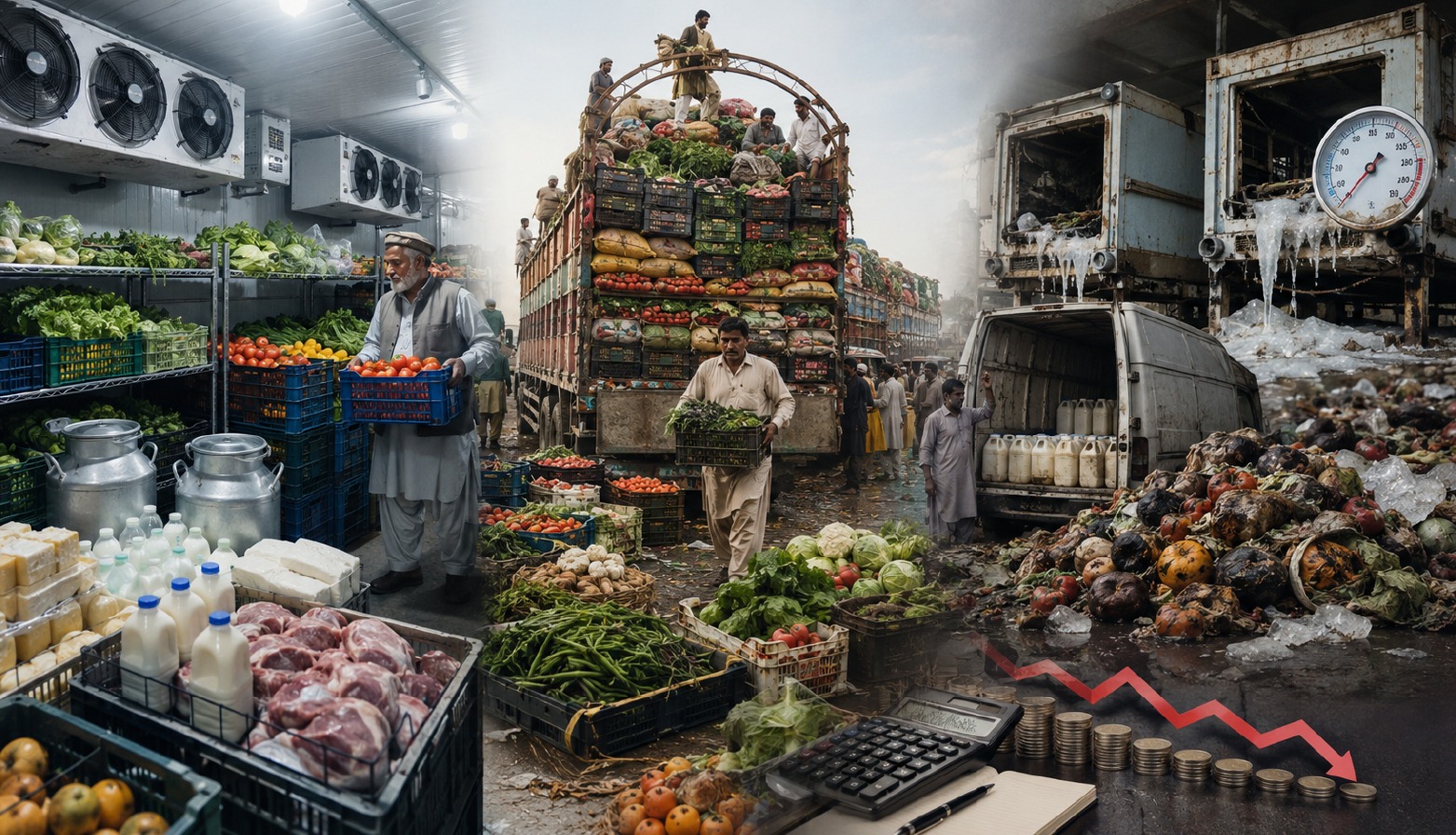
Pakistan's cold chain refrigerated trucks carrying tomatoes from Balochistan, mangoes from Sindh, milk from Punjab, and medicines from Karachi's pharmaceutical warehouses are built almost entirely on road transport. There is no meaningful refrigerated rail network. Cold chain trucks are typically larger, heavier, and burn more tyres faster than standard trucks. They also operate on thin margins because perishables spoil.
When tyre costs rise, cold chain operators face a stark choice: raise prices or cut corners on tyre maintenance. In a country where a significant portion of truck tyres are already over their safe service life, some estimates suggest 40 percent of multi-axle trucks run overloaded and wear tyres faster than the replacement schedule. Cutting corners is the more common response.
The result is a double penalty for consumers. Freight costs go up. And food spoilage increases when maintenance is deferred, which tightens supply and adds upward pressure on prices through a completely separate mechanism.
For rural operators moving agricultural produce out of Balochistan or Khyber Pakhtunkhwa, the situation is more difficult. These routes are long, the road conditions are poor, and tyre wear is faster. The difference between a profitable load and a loss-making one can come down to a single unexpected tyre failure on a mountain road, an event that becomes statistically more likely when maintenance budgets are cut.
Why General Tyre Benefits and Why That Is a Problem Worth Examining
The policy logic behind tightening anti-dumping enforcement on Chinese truck tyres is straightforward: protect domestic manufacturers, reduce import dependency, save foreign exchange.
General Tyre & Rubber Company (GTR) is Pakistan's largest domestic tyre manufacturer, producing tyres for buses, trucks, tractors, and cars. It is the only enterprise manufacturing truck and bus tyres locally at any meaningful scale. Protecting GTR's market share makes economic sense if you accept the premise that a domestic tyre industry is strategically important.
But here is the tension: GTR's local production currently meets roughly 15 percent of total tyre market demand. Legal imports meet about 25 percent. The remaining 60 percent, by some estimates, is smuggled.
When you raise duties on formal imports and enforce anti-dumping levies more aggressively, you do not automatically redirect that demand to domestic production. In Pakistan's market reality, you redirect a portion of it to the grey channel. Smuggled tyres come in through Iran's Taftan border, through Afghanistan's porous crossings, through Dubai-routed containers unloaded at Karachi and distributed before customs documentation catches up.
The Dawn newspaper has reported that smuggled tyres cost the national exchequer over Rs 70 billion annually. The Express Tribune has cited industry sources estimating that smuggled tyres represent 60 to 70 percent of the market. These are not fringe numbers. They are the market.
When the formal price of a tyre rises due to duty changes, smuggled tyres become relatively cheaper. Demand for smuggled tyres rises. The government collects less duty revenue per unit (because the units move outside formal channels), the local producer does not gain proportional market share, and the truck operator who buys formal tyres pays more, while the truck operator who buys smuggled tyres faces a different set of risks, including operating with tyres of unknown quality and age.
This is not a critique of protecting local industry. It is a note that protection-through-duties in a high-smuggling environment does not behave the same way it does in a controlled import market.
The Numbers: What Rs 5,000 to Rs 12,000 Per Tyre Actually Means at Scale
Let us ground this in figures.
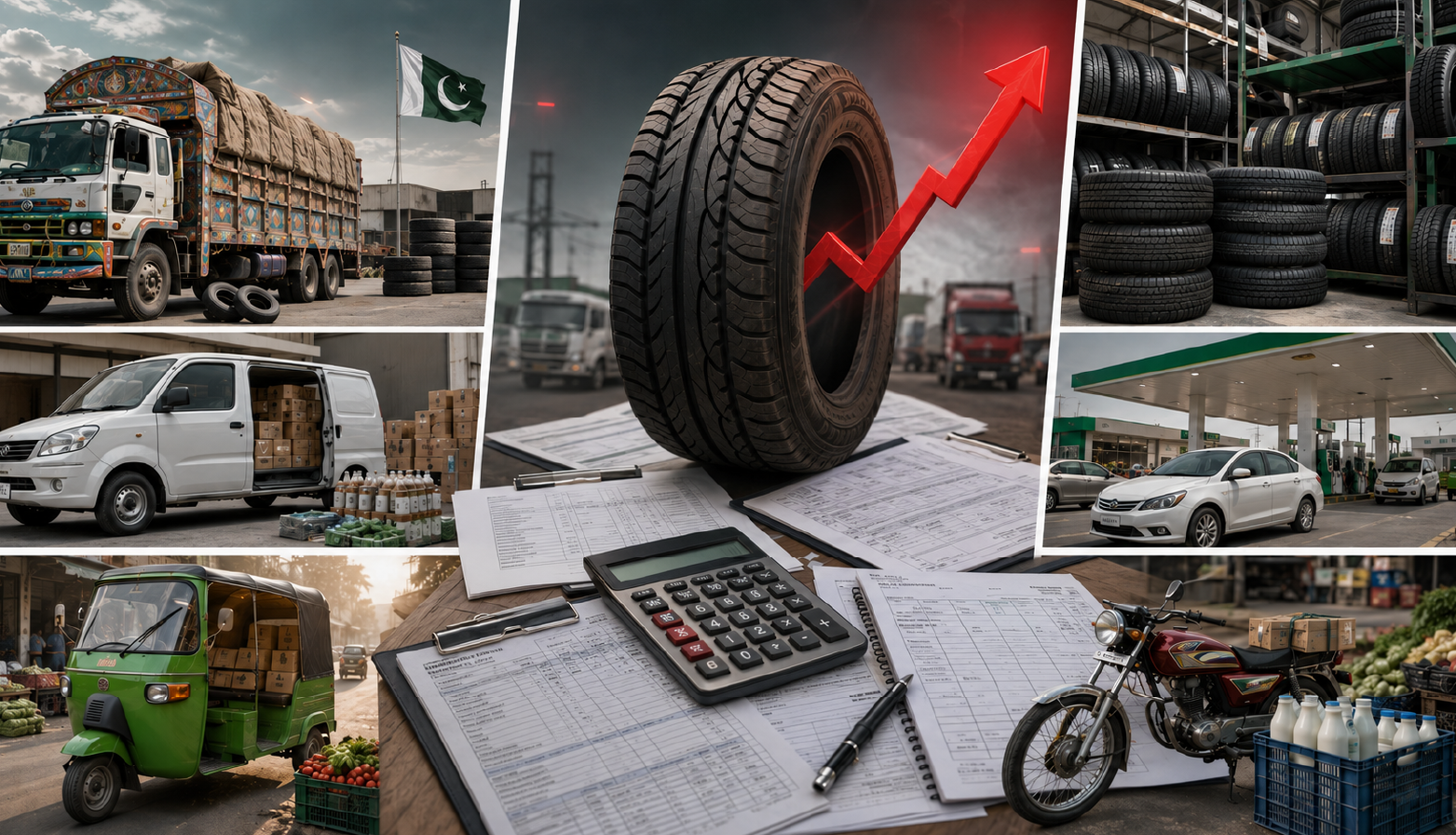
A standard truck tyre for a commercial vehicle in Pakistan the type running the Karachi-to-Peshawar corridor costs between Rs 18,000 and Rs 45,000 depending on brand, size, and source. Duty changes and anti-dumping levies on Chinese imports add a net cost premium of Rs 5,000 to Rs 12,000 per tyre on the formal market, based on the duty structure adjustments in Budget 2025-26 and prior FY years.
For a truck operator running 12 tyres on a two-axle vehicle and replacing on a standard 80,000 km rotation:
- A full tyre change-out now costs Rs 60,000 to Rs 144,000 more than it did before the duty escalation cycle.
- Annualised over a typical 120,000 km operating year, the additional tyre cost per truck is Rs 72,000 to Rs 144,000.
For Sadiq Ali's two Bedfords, that is Rs 144,000 to Rs 288,000 in additional annual operating cost from tyres alone before diesel, before toll increases, before the new carbon levy.
Freight rates on major routes have responded. On the Karachi-to-Lahore route, trucking industry sources indicate freight rates have increased 12 to 18 percent over the past 18 months, with tyre cost increases compounding diesel price effects. Intercity passenger bus fares are also expected to rise 12 to 18 percent by September 2026 as operators adjust to higher operating costs.
At the national level, the Pakistan tyre market is valued at approximately USD 2.09 billion in 2025. Even a 3 to 5 percent across-the-board cost increase in the commercial tyre segment translates to hundreds of millions of rupees in additional costs flowing through the economy all of it ultimately borne by consumers.
The Retreading Question: The Road Not Taken in This Budget
There is an alternative to the current approach that barely features in Pakistan's budget discussion: tyre retreading.
Retreading, the process of applying new tread to a used tyre casing can extend the life of a truck tyre significantly, at roughly 30 to 40 percent of the cost of a new tyre. In Europe, retreaded tyres account for a substantial share of the commercial truck tyre market. In the United States, retreading is standard practice for long-haul fleets.
In Pakistan, retreading is underutilised. There are practical reasons: road conditions accelerate casing damage, quality control in the retreading sector is inconsistent, and there is limited consumer confidence in retreaded tyres for high-speed or high-load applications. But some of these are solvable problems. Retreading incentives reduced GST on retreading materials, quality certification frameworks, and fleet tax benefits for operators using certified retreads could reduce the overall cost burden on truck operators without requiring government revenue expenditure.
This budget introduced no such incentives. The focus was on protecting domestic new-tyre production. There is nothing wrong with that goal. But the absence of a retreading policy means the cost reduction lever that most benefits small and independent truck operators, exactly the Sadiq Alis of Pakistan, was left unused.
Fleet modernisation is the other lever. Newer trucks run on more tyres more efficiently, reduce per-kilometre fuel burn, and reduce tyre wear per tonne of freight. CPEC's logistics corridors are projected to add 100,000 heavy trucks to Pakistan's roads by 2030. If those trucks run on modern multi-axle designs with better tyre efficiency, the per-unit tyre cost burden drops. But the financing structures for fleet modernisation truck loans at accessible rates remain underdeveloped in Pakistan's banking sector.
The Smuggling Surge: What Happens Next
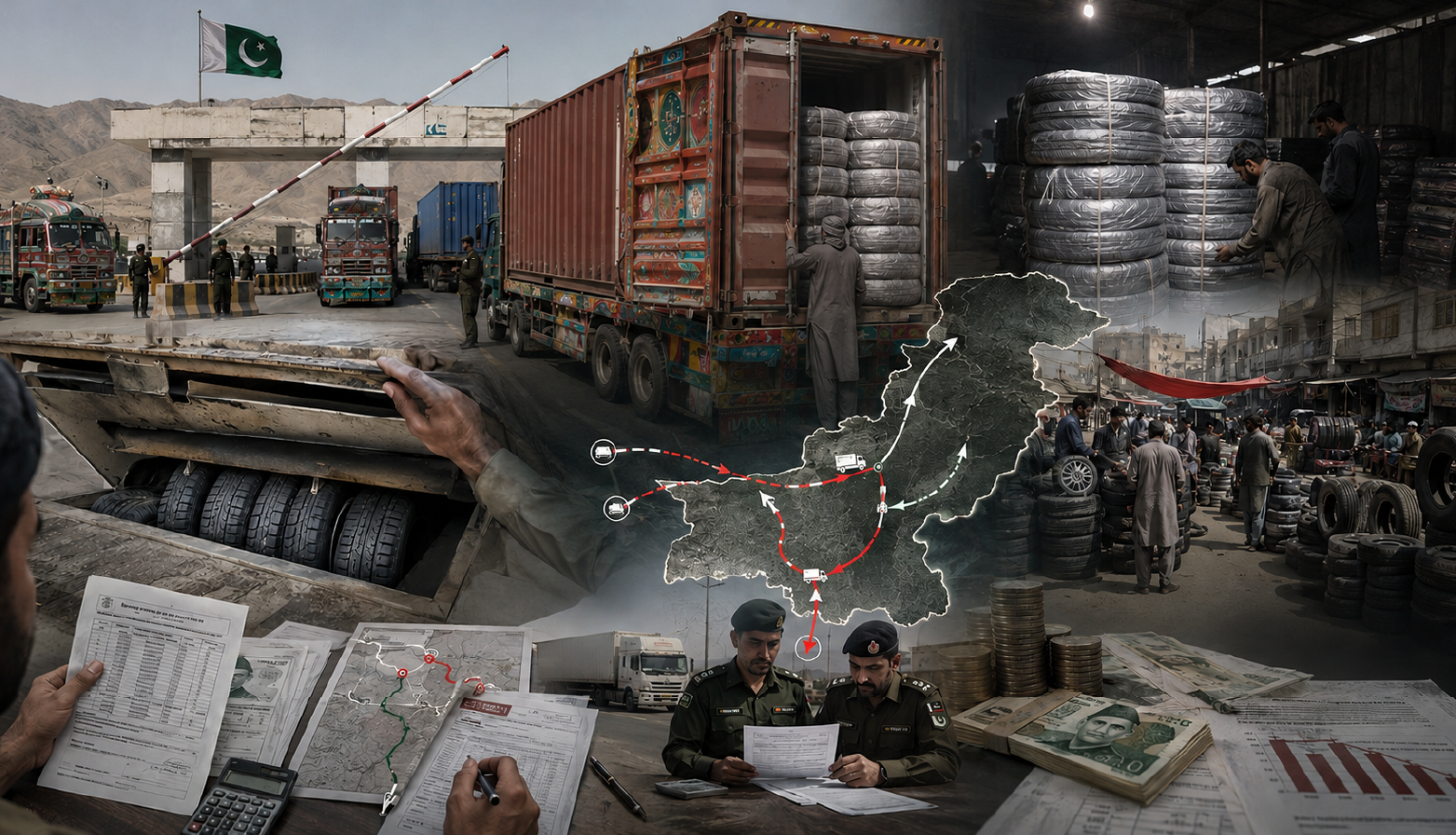
When formal tyre prices rise and smuggled alternatives stay cheap, the incentive structure for smuggling strengthens.
This is not a speculation. It is an observed pattern in Pakistan's tyre sector. The Pakistan Tyre Importers & Dealers Association and GTR management have both publicly warned that smuggling volumes increase in direct response to duty increases that widen the gap between formal and informal market prices.
The Iran-Pakistan border at Taftan and the Afghanistan-Pakistan crossings in Balochistan and KPK are the primary entry points for smuggled tyres. Afghan Transit Trade (ATT) provisions, which allow goods to transit through Pakistan to Afghanistan, have historically been used to import tyres that are then redirected into the Pakistani market without paying customs duties. Industry sources have urged the government to audit ATT tyre import data against Afghanistan's actual vehicle population, noting that the numbers do not align.
If anti-dumping enforcement raises formal prices but does not simultaneously tighten border controls and ATT auditing, the outcome is predictable: more smuggling, less duty revenue, no meaningful gain for domestic production, and a two-tier market where compliant operators pay more while non-compliant ones continue to undercut them.
This is the structural contradiction at the heart of Pakistan's tyre duty policy. It protects a formal market segment that represents a minority of the actual market volume. And every time it raises formal prices without addressing the informal supply, it hands a competitive advantage to the grey market.
CPI Under-Captures This. Here Is Why That Matters.
Pakistan's official inflation measurement, the Consumer Price Index, tracks a basket of goods and services at the retail level. It captures what you pay for flour at the store. It does not directly capture the cost of the truck that brought the flour from the mill, or the cost of the tyre on that truck.
This is a structural gap in how inflation is measured, and it is not unique to Pakistan. But it matters more in an economy where road freight dependency is nearly total and where the supply chain between producer and consumer often involves three to five transport legs, each adding a small cost premium.
When freight costs rise by 12 to 18 percent, and the CPI-measured price of food rises by 3 to 5 percent over the same period, part of the explanation for the gap between measured and felt inflation sits in exactly this mechanism. Consumers feel it. The data does not fully show it.
There is also a compounding effect. Tyre costs are not a one-time event. Every subsequent budget cycle that increases duties adds to a base that is already higher than it was before. A truck operator who absorbed the previous duty increase and adjusted his rates now faces another increase on top of that adjusted rate. The compounding is real, and it moves through supply chains in ways that are delayed, diffuse, and very hard to reverse quickly.
Who Gets Hit Hardest
Low-income households spend a higher proportion of their income on food and essential goods. When supply chain costs rise, the proportional impact on lower-income consumers is larger than on higher-income ones. This is standard economics.
But in Pakistan, there is a geographic dimension too. Rural consumers, those farthest from production centres and ports, pay the highest freight premium on goods. A bag of flour in Khuzdar or Chitral already costs more than the same bag in Karachi, because of the freight embedded in its price. When freight rates rise, the increment in rural areas is proportionally larger.
Agricultural communities that both produce and consume through road supply chains are doubly exposed: their inputs (fertiliser, seed, fuel, equipment) arrive by road and cost more, and their produce travels to market by road at higher freight rates. The farm-gate price they receive does not automatically rise to compensate. The middleman captures the difference, or the produce simply does not move because the economics no longer work.
This is the human geography of the tyre tax. It is most visible not in Karachi's import data or Islamabad's budget tables. It shows up in the price of onions in Gilgit, in the frequency of trips a Balochistan-based agricultural hauler can make before the costs exceed his returns.
Predictions: What the Next 12 Months Look Like
Based on the budget changes, the ongoing carbon levy on diesel, and the structural dynamics of Pakistan's tyre market, here is what the evidence points toward:
Freight rates will continue rising. Intercity road freight on major corridors is likely to increase 12 to 18 percent by September 2026, with the full compounding of tyre costs, diesel levies, and operator cost adjustments working through the market.
Smuggling volumes will increase. The widening price gap between formally imported and smuggled tyres, particularly from Iran and through ATT misuse, will attract higher smuggling volumes. Unless border enforcement is significantly strengthened (there is no clear budget allocation for this), the formal market will not gain the share intended by the protection policy.
Consumer prices will rise beyond official CPI estimates. The official budget impact assessment estimated a 0.5 to 1 percent incremental inflation effect from budget changes. The second-order freight cost effects on food, medicine, and consumer goods will likely push the real consumer experience to 1.5 to 2.5 percent above that baseline, concentrated in the second and third quarters of FY2025-26.
The retreading and fleet modernisation gap will widen. Without policy support for retreading or truck fleet financing, small operators will increasingly defer maintenance, raising road safety risks and supply reliability concerns, particularly on rural routes.
The Close: Next Time Flour Gets Expensive, Check the Annexure
Pakistan's newspapers will report the next increase in flour prices. Analysts will blame the rupee. Commentators will reference wheat import volumes or Punjab's harvest yields. Some will point to the petroleum levy. All of those things matter.
But buried inside the customs annexure of the budget that most people never read is a set of tyre duty changes that are also responsible. They worked through Sadiq Ali's freight rate, through the distributor's margin adjustment, through the retailer's shelf price and they ended up in your basket.
The tyre is not glamorous policy. It does not make speeches or press conferences. Nobody campaigns on the truck tyre as a kitchen table issue. But 96 percent of everything that reaches your kitchen table sat on one at some point in its journey.
And the next time you feel the price of groceries tighten, before you blame the crop or the dollar, take a moment to think about what is keeping the truck on the road. And what it is costing to keep it there. For more updates, visit DrivePK.com
Frequently Asked Questions
What changes did Budget 2025-26 make to tyre duties in Pakistan?
The budget tightened anti-dumping enforcement on Chinese truck and bus tyres while maintaining an 18 percent GST on tyre raw materials including rubber and carbon black. Combined with a new carbon levy on diesel, the net effect is a higher operating cost for truck operators particularly those buying tyres through formal channels.
How much does the tyre duty increase add to truck operating costs?
Estimates based on the duty structure and market tyre prices suggest Rs 5,000 to Rs 12,000 more per tyre for commercial truck tyres in the formal market. For a truck changing 12 tyres per year, that is Rs 60,000 to Rs 144,000 in additional annual cost per vehicle.
Why do tyre costs affect food and medicine prices?
Because 96 percent of Pakistan's freight moves by road. Every shipment of flour, rice, medicine, vegetables, or packaged goods travels on trucks. When truck operating costs rise including tyre costs freight rates rise. Those higher freight rates are built into the price of every product sold at retail.
Will smuggling increase as a result of these changes?
The evidence from previous duty cycles suggests yes. When formal tyre prices rise and the price gap with smuggled alternatives widens, smuggling volumes through Iran and Afghanistan typically increase. Unless border enforcement and ATT auditing are strengthened simultaneously, the formal market share is unlikely to grow as intended.
What is retreading and why does it matter?
Retreading is the process of applying new tread to a worn but structurally sound tyre casing. It can extend tyre life at 30 to 40 percent of the cost of a new tyre. Budget 2025-26 introduced no retreading incentives. For small truck operators, retreading support would have directly reduced operating costs without requiring government revenue expenditure.
How will intercity bus and freight rates change by late 2026?
Based on the compounding of increases in tyre costs and diesel carbon levies, intercity freight rates on major routes are expected to rise by 12 to 18 percent by September 2026. Passenger bus fares on long-haul routes are likely to follow a similar trajectory.
Tags
Share this article
About the Author

Najeeb Khan
Automotive enthusiast and writer
Comments (0)
Login Required
You need to be logged in to comment on this article.
No comments yet. Be the first to share your thoughts!
Related Articles
Margalla Underpass on Islamabad Park Road Opening Soon
Margalla Underpass’ July 30 opening passed without official confirmation. Commuters should keep current routes until CDA or ITP issues an advisory.
Lahore E-Challans: 2.9 Million Vehicles Face Action
Lahore drivers beware: police are targeting persistent e-challan defaulters, with 2.9m vehicles flagged. Check your record and carry payment proof.
Omoda 7 Premium vs MG HS: Which SUV Is Better?
Omoda 7 Premium vs MG HS Super Hybrid: Pakistan’s Rs450,000 price gap matters, but missing specs and fees could change the real deal.